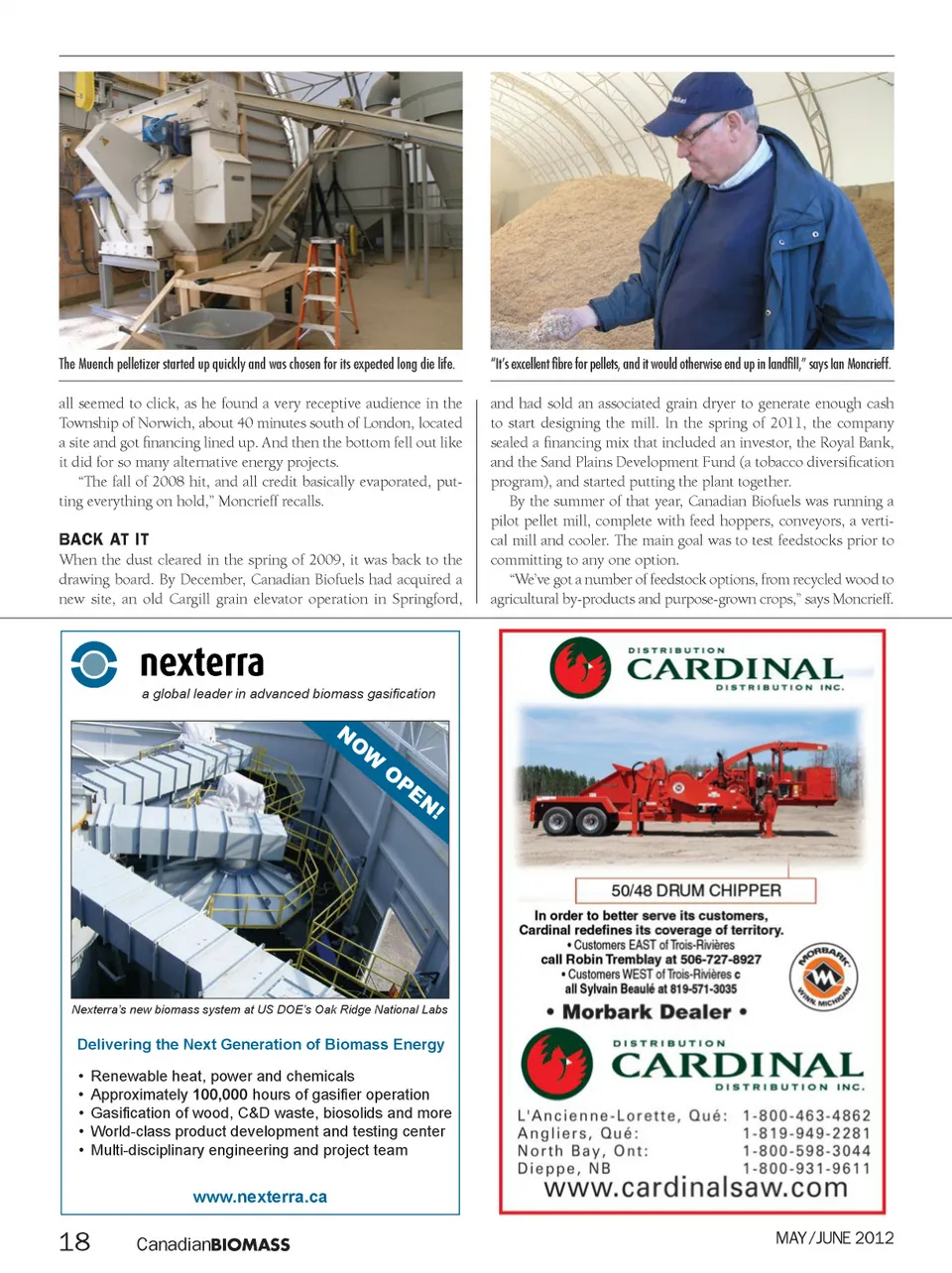
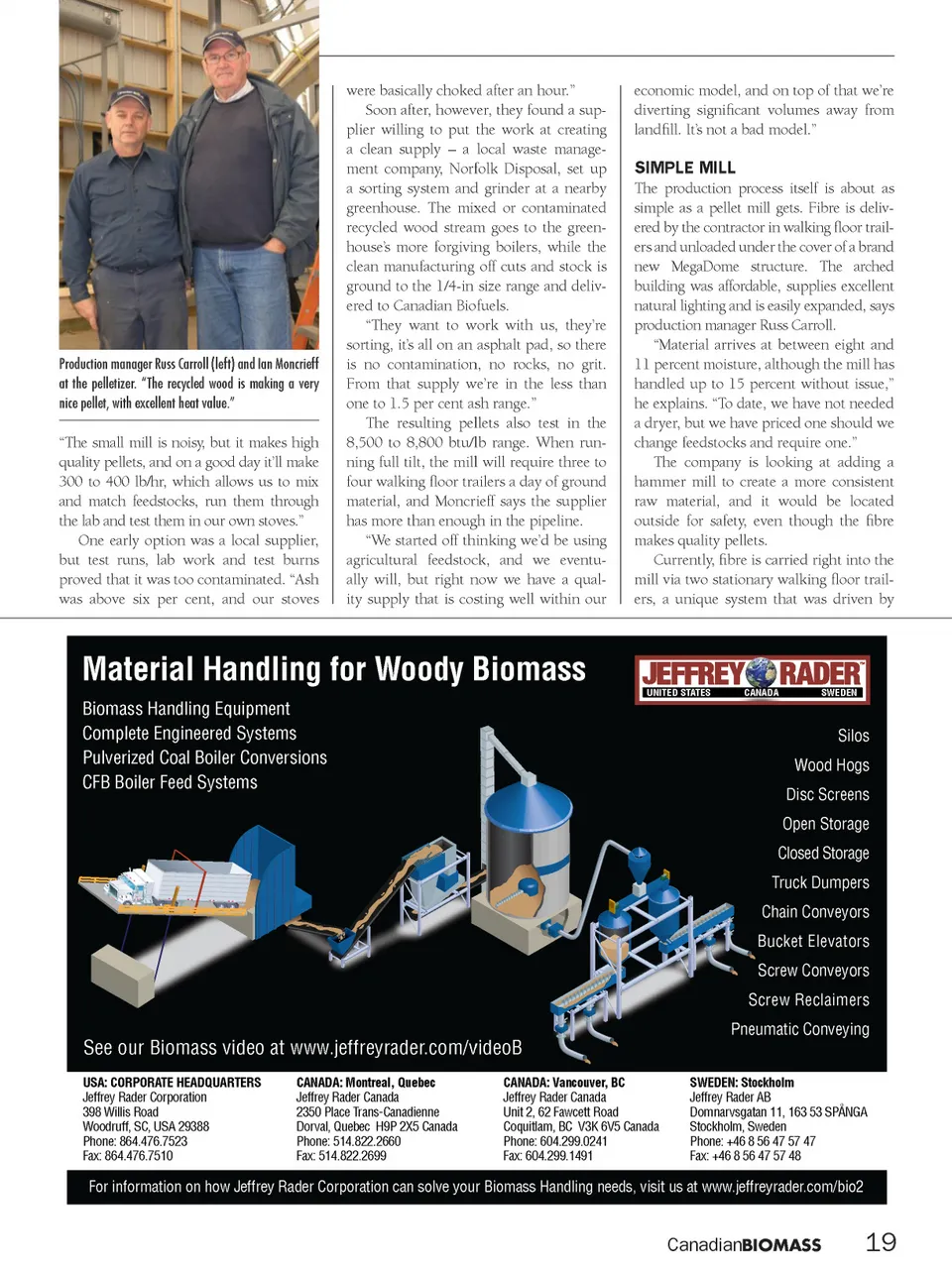
Production manager Russ Carroll (left) and Ian Moncrieff at the pelletizer. “The recycled wood is making a very fa[]h]dd]l$oal`]p[]dd]fl`]YlnYdm]&�b; “The small mill is noisy, but it makes high quality pellets, and on a good day it’ll make 300 to 400 lb/hr, which allows us to mix and match feedstocks, run them through the lab and test them in our own stoves.” One early option was a local supplier, but test runs, lab work and test burns proved that it was too contaminated. “Ash was above six per cent, and our stoves were basically choked after an hour.” Soon after, however, they found a sup-plier willing to put the work at creating a clean supply – a local waste manage-ment company, Norfolk Disposal, set up a sorting system and grinder at a nearby greenhouse. The mixed or contaminated recycled wood stream goes to the green-house’s more forgiving boilers, while the clean manufacturing off cuts and stock is ground to the 1/4-in size range and deliv-ered to Canadian Biofuels. “They want to work with us, they’re sorting, it’s all on an asphalt pad, so there is no contamination, no rocks, no grit. From that supply we’re in the less than one to 1.5 per cent ash range.” The resulting pellets also test in the 8,500 to 8,800 btu/lb range. When run-ning full tilt, the mill will require three to four walking floor trailers a day of ground material, and Moncrieff says the supplier has more than enough in the pipeline. “We started off thinking we’d be using agricultural feedstock, and we eventu-ally will, but right now we have a qual-ity supply that is costing well within our economic model, and on top of that we’re diverting significant volumes away from landfill. It’s not a bad model.” SIMPLE MILL The production process itself is about as simple as a pellet mill gets. Fibre is deliv-ered by the contractor in walking floor trail-ers and unloaded under the cover of a brand new MegaDome structure. The arched building was affordable, supplies excellent natural lighting and is easily expanded, says production manager Russ Carroll. “Material arrives at between eight and 11 percent moisture, although the mill has handled up to 15 percent without issue,” he explains. “To date, we have not needed a dryer, but we have priced one should we change feedstocks and require one.” The company is looking at adding a hammer mill to create a more consistent raw material, and it would be located outside for safety, even though the fibre makes quality pellets. Currently, fibre is carried right into the mill via two stationary walking floor trail-ers, a unique system that was driven by Material Handling for Woody Biomass UNITED STATES UNITED STATES CANADA CANADA SWEDEN SWEDEN Biomass Handling Equipment Complete Engineered Systems Pulverized Coal Boiler Conversions CFB Boiler Feed Systems Silos Wood Hogs Disc Screens Open Storage Closed Storage Truck Dumpers Chain Conveyors Bucket Elevators Screw Conveyors Screw Reclaimers Pneumatic Conveying See our Biomass video at www.jeffreyrader.com/videoB USA: CORPORATE HEADQUARTERS Jeffrey Rader Corporation 398 Willis Road Woodruff, SC, USA 29388 Phone: 864.476.7523 Fax: 864.476.7510 CANADA: Montreal, Quebec Jeffrey Rader Canada 2350 Place Trans-Canadienne Dorval, Quebec H9P 2X5 Canada Phone: 514.822.2660 Fax: 514.822.2699 CANADA: Vancouver, BC Jeffrey Rader Canada Unit 2, 62 Fawcett Road Coquitlam, BC V3K 6V5 Canada Phone: 604.299.0241 Fax: 604.299.1491 SWEDEN: Stockholm Jeffrey Rader AB Domnarvsgatan 11, 163 53 SPÅNGA Stockholm, Sweden Phone: +46 8 56 47 57 47 Fax: +46 8 56 47 57 48 For information on how Jeffrey Rader Corporation can solve your Biomass Handling needs, visit us at www.jeffreyrader.com/bio2 Canadian BIOMASS 19
Canadian Biomass May/June 2012: Page 19