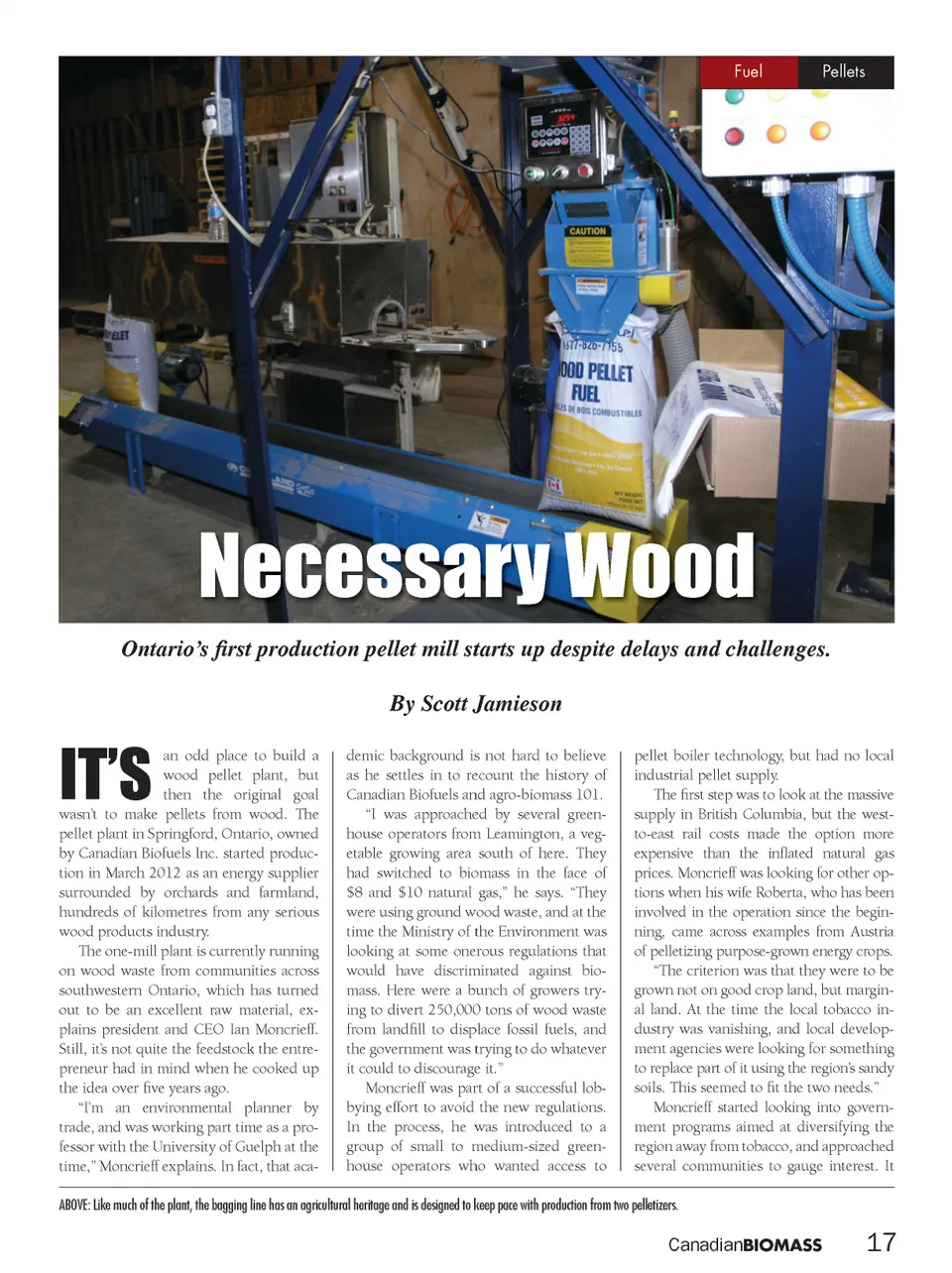
Fuel Pellets Necessary Wood Ontario’s first production pellet mill starts up despite delays and challenges. By Scott Jamieson IT’S an odd place to build a wood pellet plant, but then the original goal wasn’t to make pellets from wood. The pellet plant in Springford, Ontario, owned by Canadian Biofuels Inc. started produc-tion in March 2012 as an energy supplier surrounded by orchards and farmland, hundreds of kilometres from any serious wood products industry. The one-mill plant is currently running on wood waste from communities across southwestern Ontario, which has turned out to be an excellent raw material, ex-plains president and CEO Ian Moncrieff. Still, it’s not quite the feedstock the entre-preneur had in mind when he cooked up the idea over five years ago. “I’m an environmental planner by trade, and was working part time as a pro-fessor with the University of Guelph at the time,” Moncrieff explains. In fact, that aca-demic background is not hard to believe as he settles in to recount the history of Canadian Biofuels and agro-biomass 101. “I was approached by several green-house operators from Leamington, a veg-etable growing area south of here. They had switched to biomass in the face of $8 and $10 natural gas,” he says. “They were using ground wood waste, and at the time the Ministry of the Environment was looking at some onerous regulations that would have discriminated against bio-mass. Here were a bunch of growers try-ing to divert 250,000 tons of wood waste from landfill to displace fossil fuels, and the government was trying to do whatever it could to discourage it.” Moncrieff was part of a successful lob-bying effort to avoid the new regulations. In the process, he was introduced to a group of small to medium-sized green-house operators who wanted access to pellet boiler technology, but had no local industrial pellet supply. The first step was to look at the massive supply in British Columbia, but the west-to-east rail costs made the option more expensive than the inflated natural gas prices. Moncrieff was looking for other op-tions when his wife Roberta, who has been involved in the operation since the begin-ning, came across examples from Austria of pelletizing purpose-grown energy crops. “The criterion was that they were to be grown not on good crop land, but margin-al land. At the time the local tobacco in-dustry was vanishing, and local develop-ment agencies were looking for something to replace part of it using the region’s sandy soils. This seemed to fit the two needs.” Moncrieff started looking into govern-ment programs aimed at diversifying the region away from tobacco, and approached several communities to gauge interest. It ABOVE: Like much of the plant, the bagging line has an agricultural heritage and is designed to keep pace with production from two pelletizers. Canadian BIOMASS 17
Canadian Biomass May/June 2012: Page 17