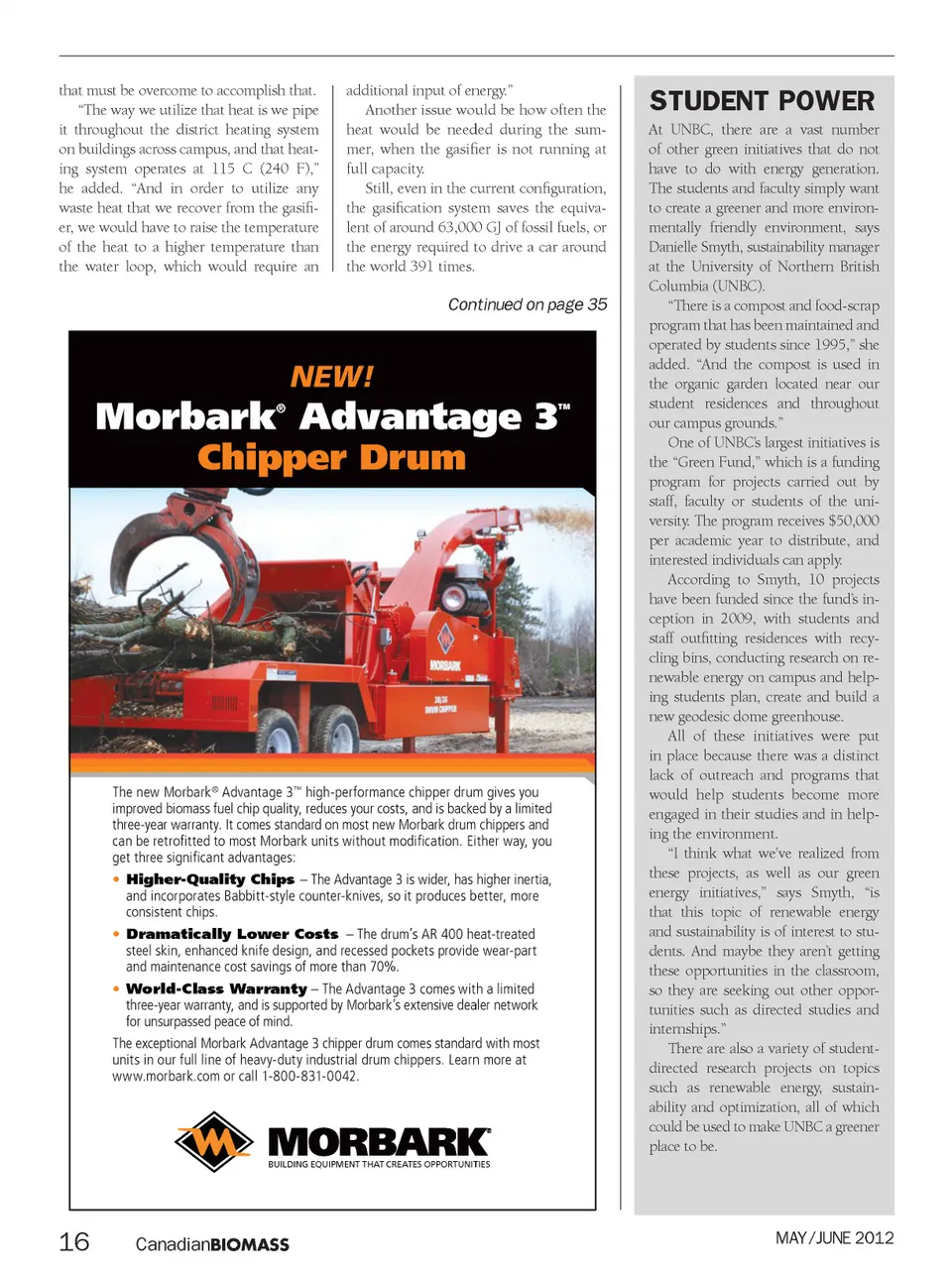
that must be overcome to accomplish that. “The way we utilize that heat is we pipe it throughout the district heating system on buildings across campus, and that heat-ing system operates at 115 C (240 F),” he added. “And in order to utilize any waste heat that we recover from the gasifi-er, we would have to raise the temperature of the heat to a higher temperature than the water loop, which would require an additional input of energy.” Another issue would be how often the heat would be needed during the sum-mer, when the gasifier is not running at full capacity. Still, even in the current configuration, the gasification system saves the equiva-lent of around 63,000 GJ of fossil fuels, or the energy required to drive a car around the world 391 times. Continued on page 35 STUDENT POWER At UNBC, there are a vast number of other green initiatives that do not have to do with energy generation. The students and faculty simply want to create a greener and more environ-mentally friendly environment, says Danielle Smyth, sustainability manager at the University of Northern British Columbia (UNBC). “There is a compost and food-scrap program that has been maintained and operated by students since 1995,” she added. “And the compost is used in the organic garden located near our student residences and throughout our campus grounds.” One of UNBC’s largest initiatives is the “Green Fund,” which is a funding program for projects carried out by staff, faculty or students of the uni-versity. The program receives $50,000 per academic year to distribute, and interested individuals can apply. According to Smyth, 10 projects have been funded since the fund’s in-ception in 2009, with students and staff outfitting residences with recy-cling bins, conducting research on re-newable energy on campus and help-ing students plan, create and build a new geodesic dome greenhouse. All of these initiatives were put in place because there was a distinct lack of outreach and programs that would help students become more engaged in their studies and in help-ing the environment. “I think what we’ve realized from these projects, as well as our green energy initiatives,” says Smyth, “is that this topic of renewable energy and sustainability is of interest to stu-dents. And maybe they aren’t getting these opportunities in the classroom, so they are seeking out other oppor-tunities such as directed studies and internships.” There are also a variety of student-directed research projects on topics such as renewable energy, sustain-ability and optimization, all of which could be used to make UNBC a greener place to be. NEW! .PSCBSL "EWBOUBHF  $IJQQFS%SVN ® ™ The new Morbark ® Advantage 3 ™ high-performance chipper drum gives you improved biomass fuel chip quality, reduces your costs, and is backed by a limited three-year warranty. It comes standard on most new Morbark drum chippers and can be retrofitted to most Morbark units without modification. Either way, you get three significant advantages: t )JHIFS�e;2VBMJUZ $IJQT – The Advantage 3 is wider, has higher inertia, and incorporates Babbitt-style counter-knives, so it produces better, more consistent chips. t %SBNBUJDBMMZ -PXFS $PTUT – The drum’s AR 400 heat-treated steel skin, enhanced knife design, and recessed pockets provide wear-part and maintenance cost savings of more than 70%. t 8PSME�e;$MBTT 8BSSBOUZ – The Advantage 3 comes with a limited three-year warranty, and is supported by Morbark’s extensive dealer network for unsurpassed peace of mind. The exceptional Morbark Advantage 3 chipper drum comes standard with most units in our full line of heavy-duty industrial drum chippers. Learn more at www.morbark.com or call 1-800-831-0042. BUILDING EQUIPMENT THAT CREATES OPPORTUNITIES 16 Canadian BIOMASS MAY/JUNE 2012
Canadian Biomass May/June 2012: Page 16