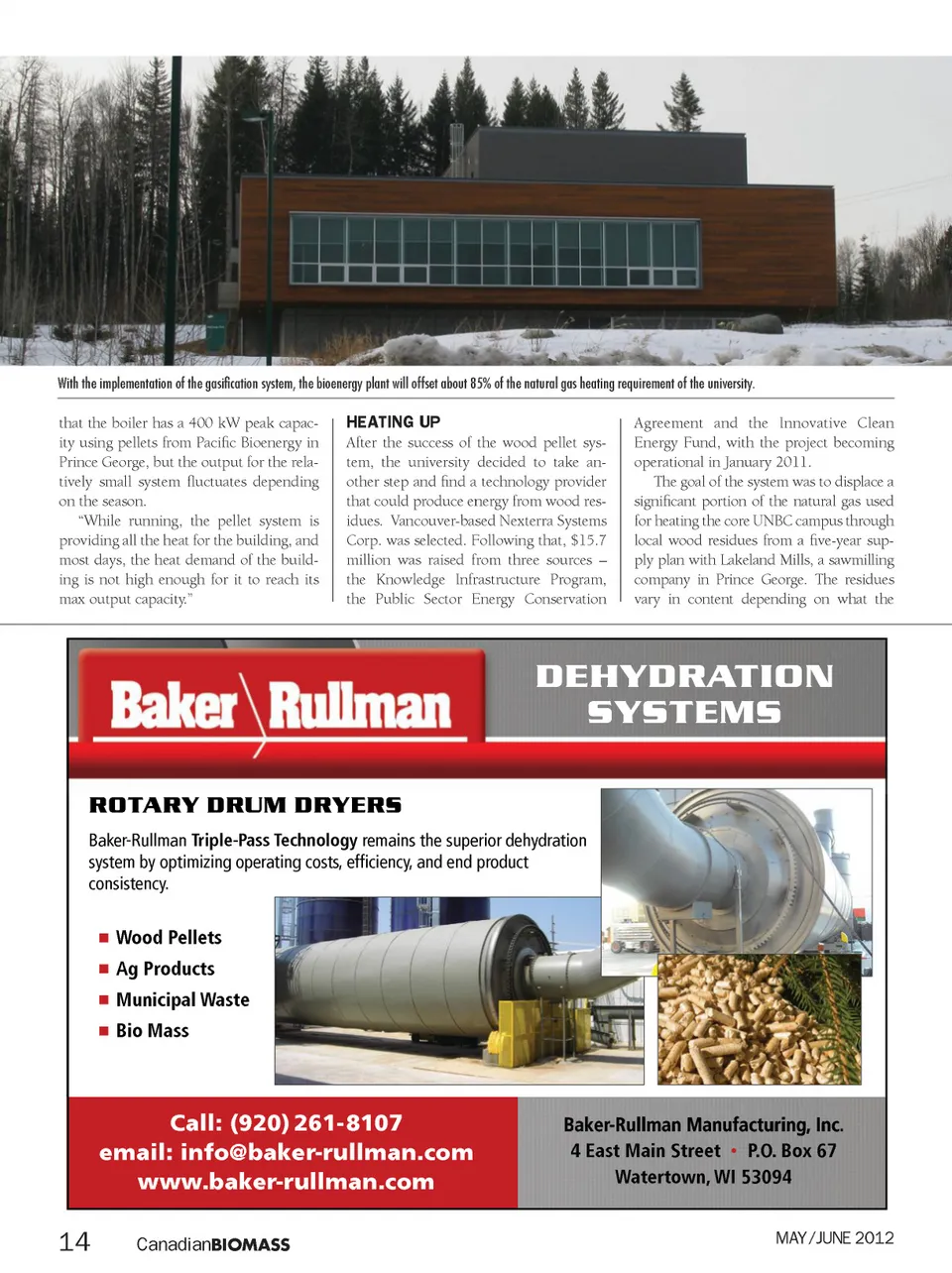
L`]c;)-&/%eaddagf_YkaÚ[Ylagfkqkl]eZ][Ye]gh]jYlagfYdafBYfmYjq*())oal`l`]]imahe]flkmhhda]\ZqF]pl]jjY Systems Corp. <Yna\;dYmkkYqkl`Yll`]_YkaÚ]jmk]kdg[Ydogg\j]ka\m]k from a local mill. supplier is sawing, which gives the univer-sity a large variety of test material to deter-mine which mix works best. “The gasification process had a num-ber of things going for it,” says Claus. “It was developed in B.C. and it was all part of the plan: the pellet system was Phase 1, the biomass gasification system was Phase 2 and we have a plan in mind to go to a Phase 3, which would generate electricity.” One option for Phase 3 that is being considered is the process that the Univer-sity of British Columbia is using – divert-ing the syngas accumulated from the top of the gasifier, cleaning it and generating electricity via an internal combustion en-gine. However, that is only one option for the problem and still very early in the planning stages. One area of research that the university is also looking into is heat recovery, as the gasifier radiates significant amounts of heat while in operation. If this heat were cap-tured, it could be used to heat other build-ings, such as the student residences, says Claus. However, there are still challenges Canadian BIOMASS 15
Canadian Biomass May/June 2012: Page 15