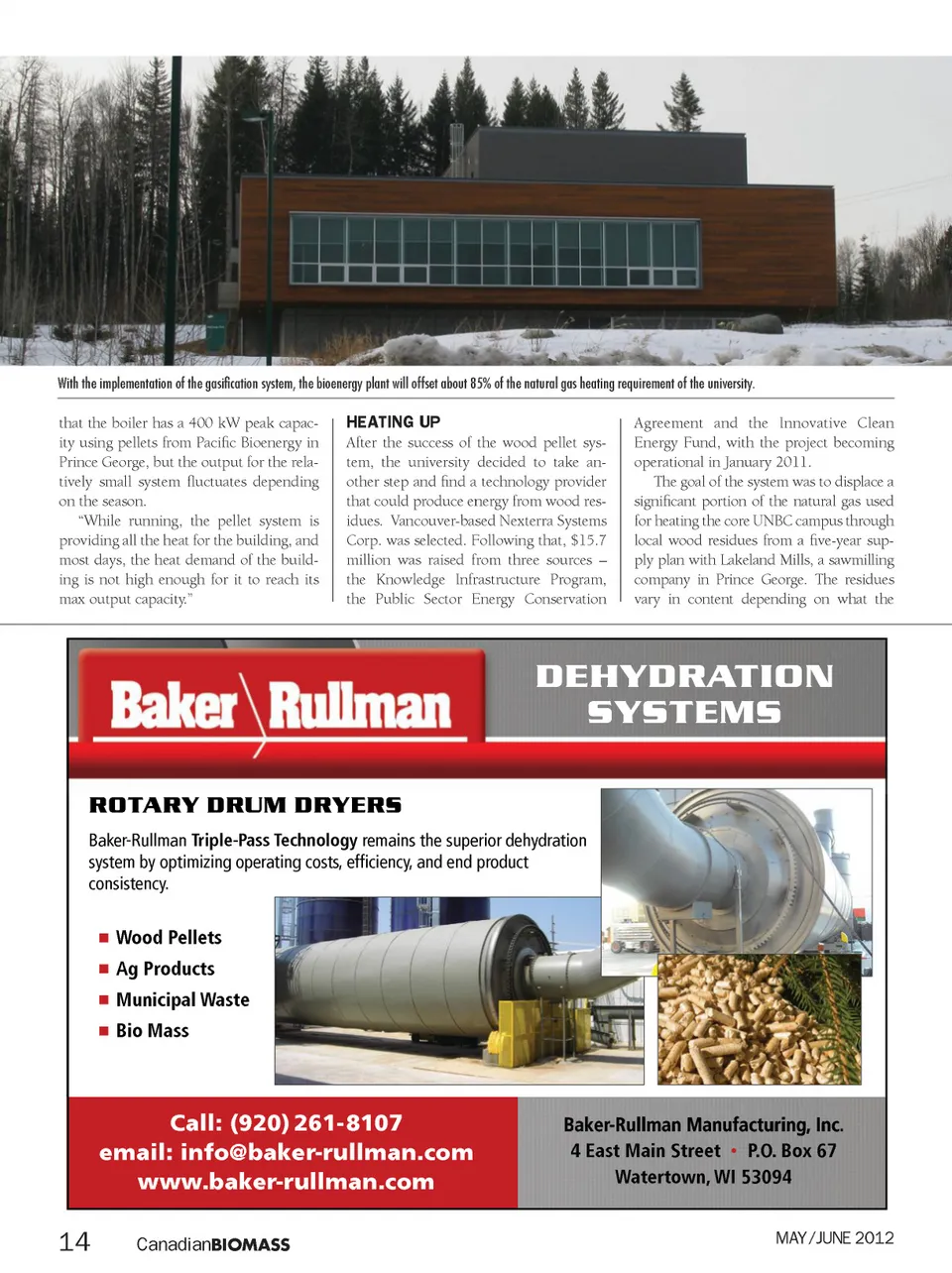
Oal`l`]aehd]e]flYlagfg^l`]_YkaÚ[Ylagfkqkl]e$l`]Zag]f]j_qhdYfloaddg^^k]lYZgml0-d;g^l`]fYlmjYd_Yk`]Ylaf_j]imaj]e]flg^l`]mfan]jkalq& that the boiler has a 400 kW peak capac-ity using pellets from Pacific Bioenergy in Prince George, but the output for the rela-tively small system fluctuates depending on the season. “While running, the pellet system is providing all the heat for the building, and most days, the heat demand of the build-ing is not high enough for it to reach its max output capacity.” HEATING UP After the success of the wood pellet sys-tem, the university decided to take an-other step and find a technology provider that could produce energy from wood res-idues. Vancouver-based Nexterra Systems Corp. was selected. Following that, $15.7 million was raised from three sources – the Knowledge Infrastructure Program, the Public Sector Energy Conservation Agreement and the Innovative Clean Energy Fund, with the project becoming operational in January 2011. The goal of the system was to displace a significant portion of the natural gas used for heating the core UNBC campus through local wood residues from a five-year sup-ply plan with Lakeland Mills, a sawmilling company in Prince George. The residues vary in content depending on what the DEHYDRATION SYSTEMS ROTARY DRUM DRYERS Baker-Rullman Triple-Pass Technology remains the superior dehydration system by optimizing operating costs, efficiency, and end product consistency. Q Q Q Q Wood Pellets Ag Products Municipal Waste Bio Mass Call: (920) 261-8107 email: [email protected] www.baker-rullman.com 14 Canadian BIOMASS 4 Ea st M ai a n St re et e P. O. O B ox 6 7 Wa te rt ow o n, WI 53 09 0 4 MAY/JUNE 2012
Canadian Biomass May/June 2012: Page 14