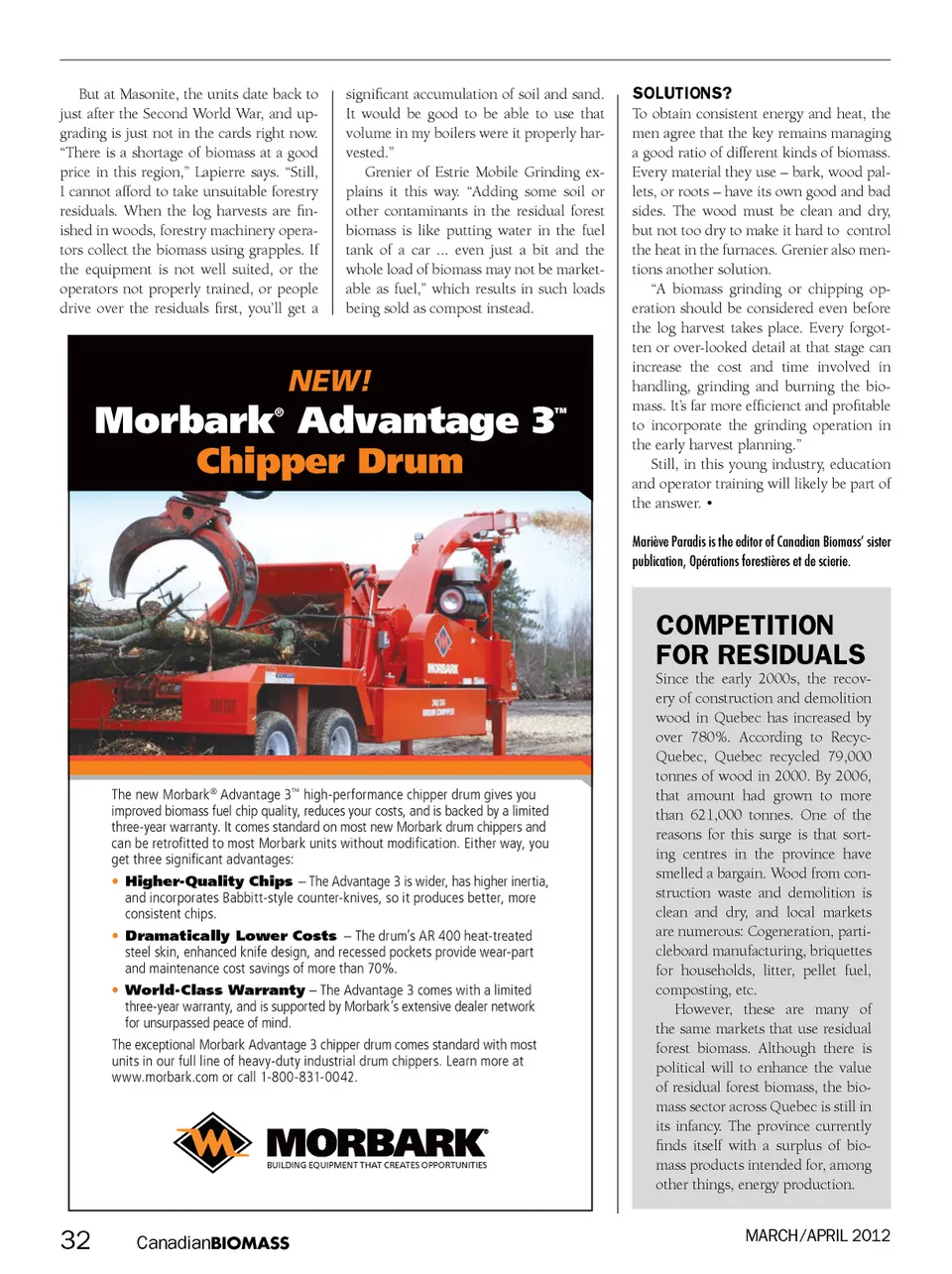
But at Masonite, the units date back to just after the Second World War, and up-grading is just not in the cards right now. “There is a shortage of biomass at a good price in this region,” Lapierre says. “Still, I cannot afford to take unsuitable forestry residuals. When the log harvests are fin-ished in woods, forestry machinery opera-tors collect the biomass using grapples. If the equipment is not well suited, or the operators not properly trained, or people drive over the residuals first, you’ll get a significant accumulation of soil and sand. It would be good to be able to use that volume in my boilers were it properly har-vested.” Grenier of Estrie Mobile Grinding ex-plains it this way. “Adding some soil or other contaminants in the residual forest biomass is like putting water in the fuel tank of a car ... even just a bit and the whole load of biomass may not be market-able as fuel,” which results in such loads being sold as compost instead. solutions? Morbark Advantage 3 Chipper Drum ® ™ NEW! To obtain consistent energy and heat, the men agree that the key remains managing a good ratio of different kinds of biomass. Every material they use – bark, wood pal-lets, or roots – have its own good and bad sides. The wood must be clean and dry, but not too dry to make it hard to control the heat in the furnaces. Grenier also men-tions another solution. “A biomass grinding or chipping op-eration should be considered even before the log harvest takes place. Every forgot-ten or over-looked detail at that stage can increase the cost and time involved in handling, grinding and burning the bio-mass. It’s far more efficienct and profitable to incorporate the grinding operation in the early harvest planning.” Still, in this young industry, education and operator training will likely be part of the answer. • Mariève Paradis is the editor of Canadian Biomass’ sister publication, Opérations forestières et de scierie. competition for residuals Since the early 2000s, the recov-ery of construction and demolition wood in Quebec has increased by over 780%. According to Recyc-Quebec, Quebec recycled 79,000 tonnes of wood in 2000. By 2006, that amount had grown to more than 621,000 tonnes. One of the reasons for this surge is that sort-ing centres in the province have smelled a bargain. Wood from con-struction waste and demolition is clean and dry, and local markets are numerous: Cogeneration, parti-cleboard manufacturing, briquettes for households, litter, pellet fuel, composting, etc. However, these are many of the same markets that use residual forest biomass. Although there is political will to enhance the value of residual forest biomass, the bio-mass sector across Quebec is still in its infancy. The province currently finds itself with a surplus of bio-mass products intended for, among other things, energy production. MARCH/APRIL 2012 The new Morbark ® Advantage 3 ™ high-performance chipper drum gives you improved biomass fuel chip quality, reduces your costs, and is backed by a limited three-year warranty. It comes standard on most new Morbark drum chippers and can be retrofitted to most Morbark units without modification. Either way, you get three significant advantages: • Higher-Quality Chips – The Advantage 3 is wider, has higher inertia, and incorporates Babbitt-style counter-knives, so it produces better, more consistent chips. • Dramatically Lower Costs – The drum’s AR 400 heat-treated steel skin, enhanced knife design, and recessed pockets provide wear-part and maintenance cost savings of more than 70%. • World-Class Warranty – The Advantage 3 comes with a limited three-year warranty, and is supported by Morbark’s extensive dealer network for unsurpassed peace of mind. The exceptional Morbark Advantage 3 chipper drum comes standard with most units in our full line of heavy-duty industrial drum chippers. Learn more at www.morbark.com or call 1-800-831-0042. Building EquipmEnt that CrEatEs OppOrtunitiEs 32 Canadian BIOMASS
Canadian Biomass March/April 2012: Page 32