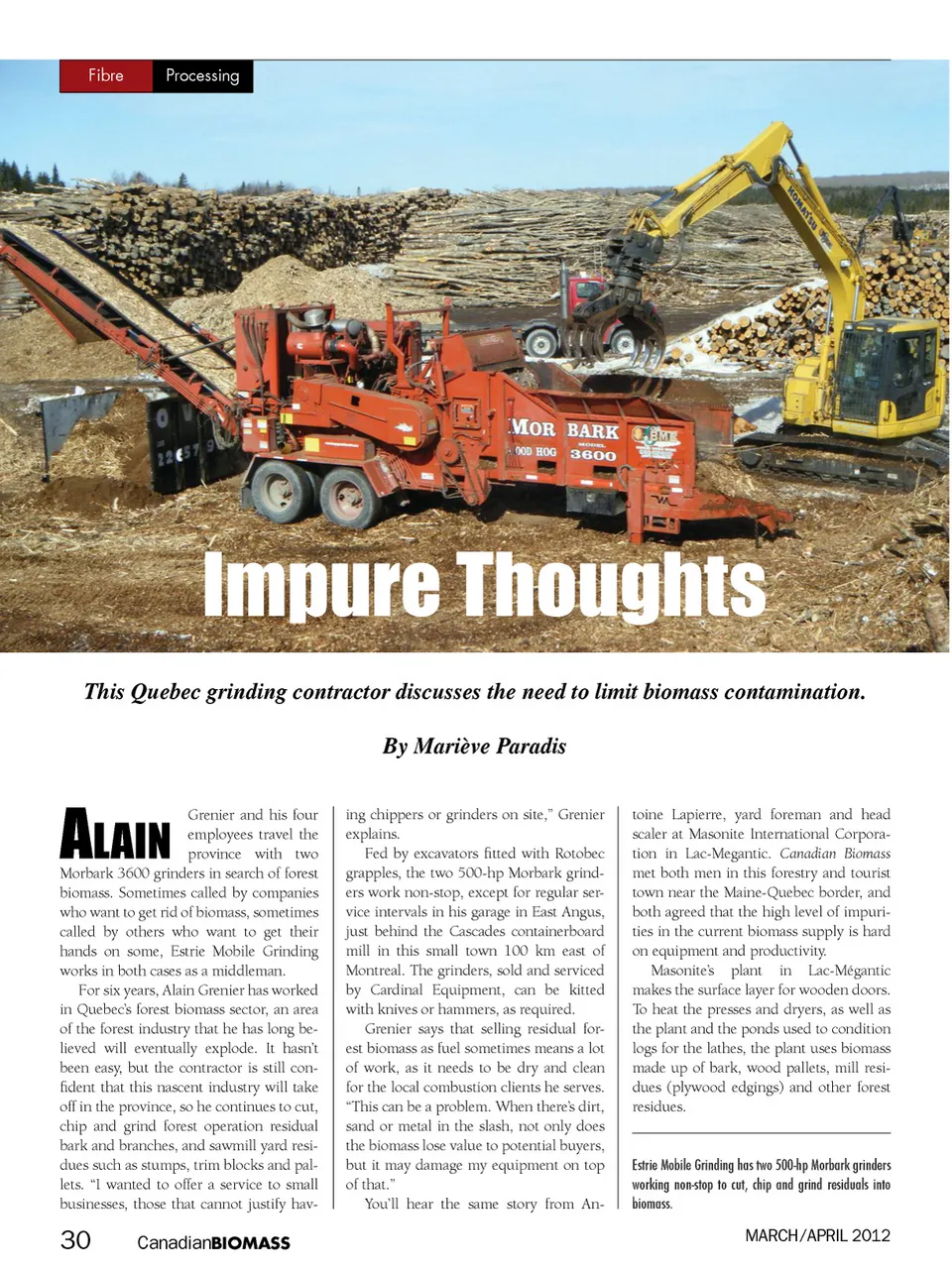
“With the current technology and im-provements in plant efficiency, we no lon-ger produce enough residue to fuel our boilers. We have to buy biomass for heat in winter,” says Lapierre, which is a good problem to have. In total, nearly 3,800 tonnes of biomass are purchased as boiler fuel, with mill residues now accounting for only 50% of the boiler fibre supply. To create the supplemental supply, Es-trie Mobile Grinding brings its equipment to the mill yard two or three times a year. The crew grinds stumps, bark, pallets and other byproducts. When this mixed bag of biomass con-tains impurities such as rock and sand, the consequences can be disastrous. “We need to clean the combustion chamber twice a day to avoid the vitrifi-cation of these impurities,” Lapierre ex-plains. Once that happens, the impurities harden and condense to become large blocks of glass. Newer biomass installa-tions have removable floors under the chambers for the regular removal of de-posits or “klinkers.” Behind the Masonite plant, mill and forest residues, stumps and pallets are ground two or three times per year. CONFERENCE & EXHIBITION GROWING THE BIOECONOMY 2012 JUNE 13-15, 2012 Prince George, BC Speaker Highlights bioenergyconference.org • 250-961-6611 Conference Co-Host • • • • • • • • • Radio Hon. Steve Thomson , BC Minister of Forests Christiane Egger, Upper Austrian Energy Agency Dave Lovekin, Pembina Institute, Canada Klaus Trattner, Andritz AG, Austria Bengt-Erik Lofgren, AFAB, Sweden Pernille Overbye, Ramboll, Denmark John Swaan, Horizon Bioenergy, Netherlands Graeme Bethell, Gussing Renewable Energy Canada Gordon Murray, Wood Pellet Association of Canada THECITIZEN PRINCE GEORGE Canadian BIOMASS 31
Canadian Biomass March/April 2012: Page 31