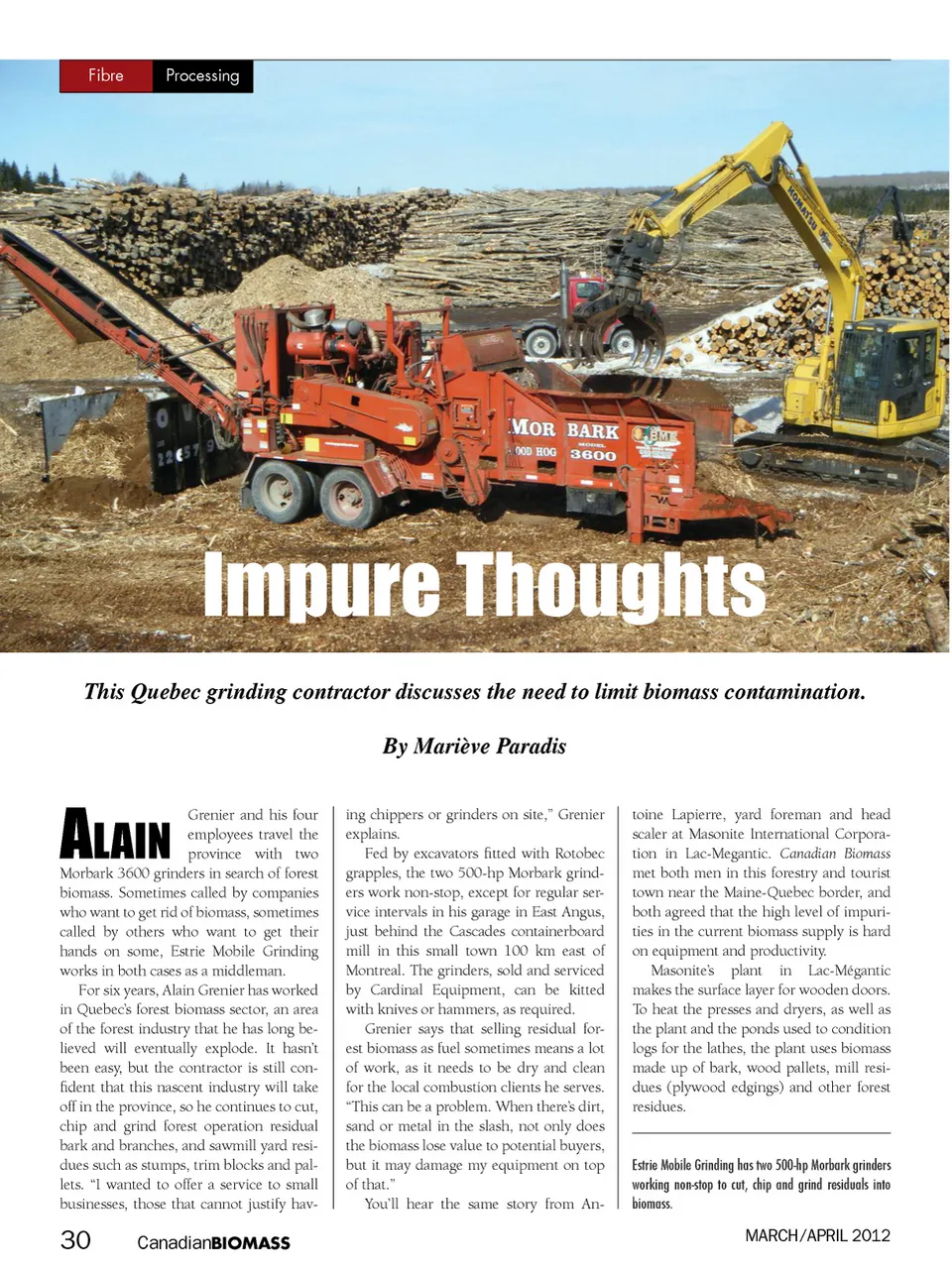
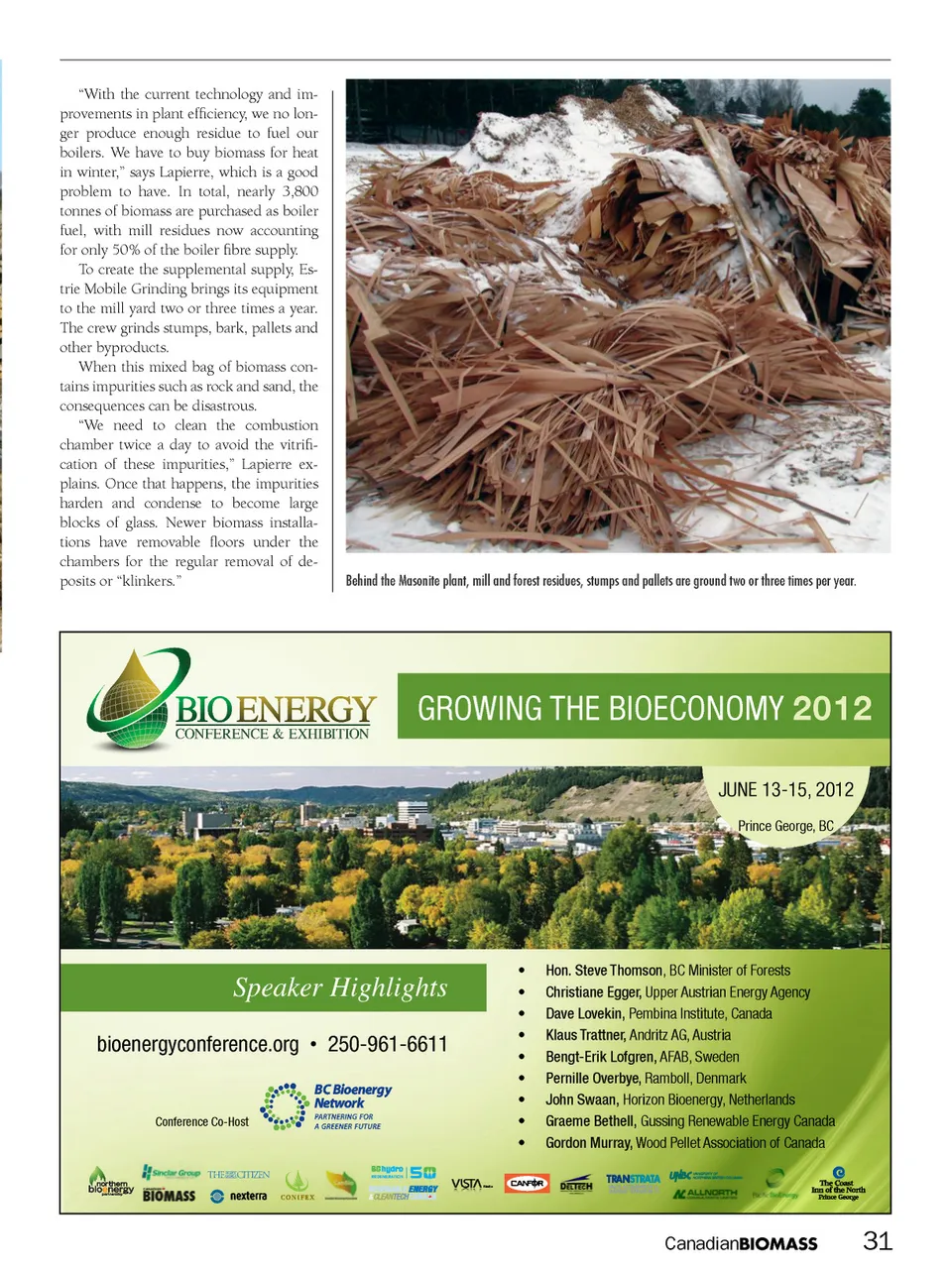
Fibre Processing Impure Thoughts This Quebec grinding contractor discusses the need to limit biomass contamination. By Mariève Paradis a laiN Grenier and his four employees travel the province with two Morbark 3600 grinders in search of forest biomass. Sometimes called by companies who want to get rid of biomass, sometimes called by others who want to get their hands on some, Estrie Mobile Grinding works in both cases as a middleman. For six years, Alain Grenier has worked in Quebec’s forest biomass sector, an area of the forest industry that he has long be-lieved will eventually explode. It hasn’t been easy, but the contractor is still con-fident that this nascent industry will take off in the province, so he continues to cut, chip and grind forest operation residual bark and branches, and sawmill yard resi-dues such as stumps, trim blocks and pal-lets. “I wanted to offer a service to small businesses, those that cannot justify hav-ing chippers or grinders on site,” Grenier explains. Fed by excavators fitted with Rotobec grapples, the two 500-hp Morbark grind-ers work non-stop, except for regular ser-vice intervals in his garage in East Angus, just behind the Cascades containerboard mill in this small town 100 km east of Montreal. The grinders, sold and serviced by Cardinal Equipment, can be kitted with knives or hammers, as required. Grenier says that selling residual for-est biomass as fuel sometimes means a lot of work, as it needs to be dry and clean for the local combustion clients he serves. “This can be a problem. When there’s dirt, sand or metal in the slash, not only does the biomass lose value to potential buyers, but it may damage my equipment on top of that.” You’ll hear the same story from An-toine Lapierre, yard foreman and head scaler at Masonite International Corpora-tion in Lac-Megantic. Canadian Biomass met both men in this forestry and tourist town near the Maine-Quebec border, and both agreed that the high level of impuri-ties in the current biomass supply is hard on equipment and productivity. Masonite’s plant in Lac-Mégantic makes the surface layer for wooden doors. To heat the presses and dryers, as well as the plant and the ponds used to condition logs for the lathes, the plant uses biomass made up of bark, wood pallets, mill resi-dues (plywood edgings) and other forest residues. Estrie Mobile Grinding has two 500-hp Morbark grinders working non-stop to cut, chip and grind residuals into biomass. MARCH/APRIL 2012 30 Canadian BIOMASS
Canadian Biomass March/April 2012: Page 30