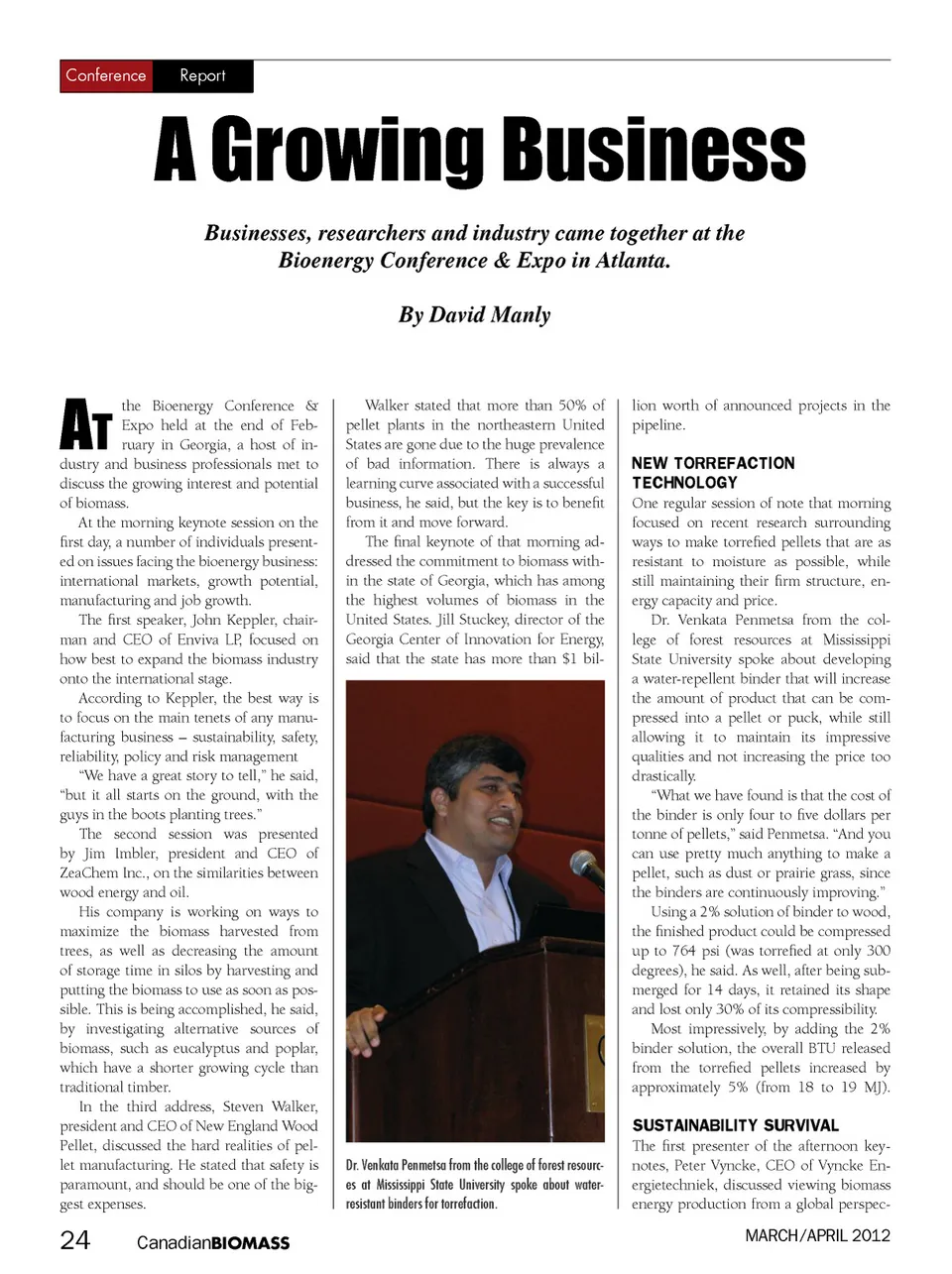
Conference Report A Growing Business Businesses, researchers and industry came together at the Bioenergy Conference & Expo in Atlanta. By David Manly the Bioenergy Conference & Expo held at the end of Feb-ruary in Georgia, a host of in-dustry and business professionals met to discuss the growing interest and potential of biomass. At the morning keynote session on the first day, a number of individuals present-ed on issues facing the bioenergy business: international markets, growth potential, manufacturing and job growth. The first speaker, John Keppler, chair-man and CEO of Enviva LP, focused on how best to expand the biomass industry onto the international stage. According to Keppler, the best way is to focus on the main tenets of any manu-facturing business – sustainability, safety, reliability, policy and risk management “We have a great story to tell,” he said, “but it all starts on the ground, with the guys in the boots planting trees.” The second session was presented by Jim Imbler, president and CEO of ZeaChem Inc., on the similarities between wood energy and oil. His company is working on ways to maximize the biomass harvested from trees, as well as decreasing the amount of storage time in silos by harvesting and putting the biomass to use as soon as pos-sible. This is being accomplished, he said, by investigating alternative sources of biomass, such as eucalyptus and poplar, which have a shorter growing cycle than traditional timber. In the third address, Steven Walker, president and CEO of New England Wood Pellet, discussed the hard realities of pel-let manufacturing. He stated that safety is paramount, and should be one of the big-gest expenses. a t Walker stated that more than 50% of pellet plants in the northeastern United States are gone due to the huge prevalence of bad information. There is always a learning curve associated with a successful business, he said, but the key is to benefit from it and move forward. The final keynote of that morning ad-dressed the commitment to biomass with-in the state of Georgia, which has among the highest volumes of biomass in the United States. Jill Stuckey, director of the Georgia Center of Innovation for Energy, said that the state has more than $1 bil-lion worth of announced projects in the pipeline. new torrefaction technology One regular session of note that morning focused on recent research surrounding ways to make torrefied pellets that are as resistant to moisture as possible, while still maintaining their firm structure, en-ergy capacity and price. Dr. Venkata Penmetsa from the col-lege of forest resources at Mississippi State University spoke about developing a water-repellent binder that will increase the amount of product that can be com-pressed into a pellet or puck, while still allowing it to maintain its impressive qualities and not increasing the price too drastically. “What we have found is that the cost of the binder is only four to five dollars per tonne of pellets,” said Penmetsa. “And you can use pretty much anything to make a pellet, such as dust or prairie grass, since the binders are continuously improving.” Using a 2% solution of binder to wood, the finished product could be compressed up to 764 psi (was torrefied at only 300 degrees), he said. As well, after being sub-merged for 14 days, it retained its shape and lost only 30% of its compressibility. Most impressively, by adding the 2% binder solution, the overall BTU released from the torrefied pellets increased by approximately 5% (from 18 to 19 MJ). sustainaBility survival Dr. Venkata Penmetsa from the college of forest resourc-es at Mississippi State University spoke about water-resistant binders for torrefaction. The first presenter of the afternoon key-notes, Peter Vyncke, CEO of Vyncke En-ergietechniek, discussed viewing biomass energy production from a global perspec-MARCH/APRIL 2012 24 Canadian BIOMASS
Canadian Biomass March/April 2012: Page 24