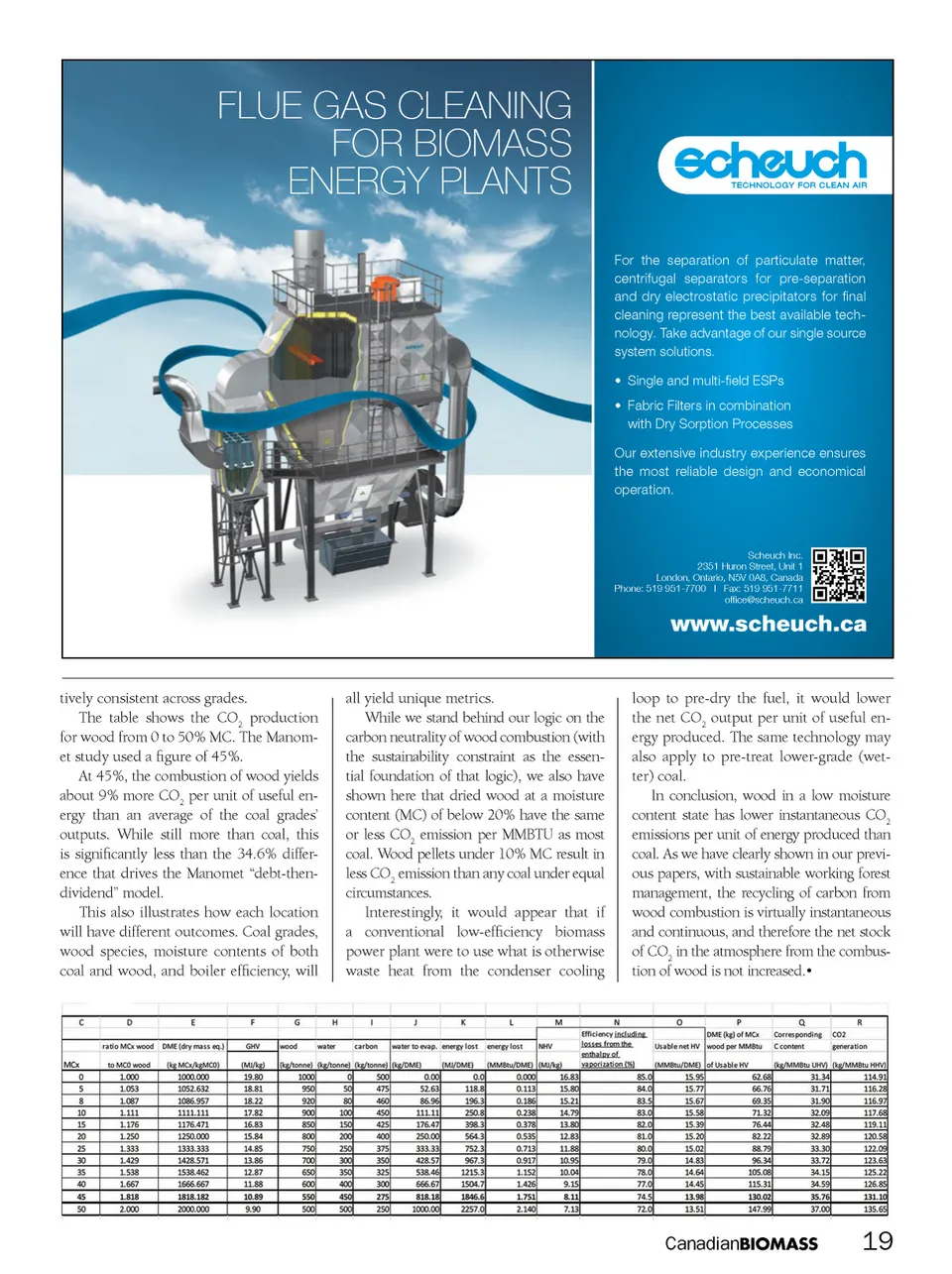
FLUE GAS CLEANING FOR BIOMASS ENERGY PLANTS For the separation of particulate matter, centri fugal separators for pre-separation and dry electrostatic precipitators for fi nal cleaning represent the best available tech-nology. Take advantage of our single source system solutions. • Single and multi-fi eld ESPs • Fabric Filters in combination with Dry Sorption Processes Our extensive industry experience ensures the most reliable design and economical operation. Scheuch Inc. 2351 Huron Street, Unit 1 London, Ontario, N5V 0A8, Canada Phone: 519 951-7700 I Fax: 519 951-7711 offi [email protected] www.scheuch.ca Biomass_SEF_177_8x127_CA_090312_RZ.indd 1 09.03.12 11:36 tively consistent across grades. The table shows the CO 2 production for wood from 0 to 50% MC. The Manom-et study used a figure of 45%. At 45%, the combustion of wood yields about 9% more CO 2 per unit of useful en-ergy than an average of the coal grades’ outputs. While still more than coal, this is significantly less than the 34.6% differ-ence that drives the Manomet “debt-then-dividend” model. This also illustrates how each location will have different outcomes. Coal grades, wood species, moisture contents of both coal and wood, and boiler efficiency, will all yield unique metrics. While we stand behind our logic on the carbon neutrality of wood combustion (with the sustainability constraint as the essen-tial foundation of that logic), we also have shown here that dried wood at a moisture content (MC) of below 20% have the same or less CO 2 emission per MMBTU as most coal. Wood pellets under 10% MC result in less CO 2 emission than any coal under equal circumstances. Interestingly, it would appear that if a conventional low-efficiency biomass power plant were to use what is otherwise waste heat from the condenser cooling loop to pre-dry the fuel, it would lower the net CO 2 output per unit of useful en-ergy produced. The same technology may also apply to pre-treat lower-grade (wet-ter) coal. In conclusion, wood in a low moisture content state has lower instantaneous CO 2 emissions per unit of energy produced than coal. As we have clearly shown in our previ-ous papers, with sustainable working forest management, the recycling of carbon from wood combustion is virtually instantaneous and continuous, and therefore the net stock of CO 2 in the atmosphere from the combus-tion of wood is not increased.• Canadian BIOMASS 19
Canadian Biomass March/April 2012: Page 19