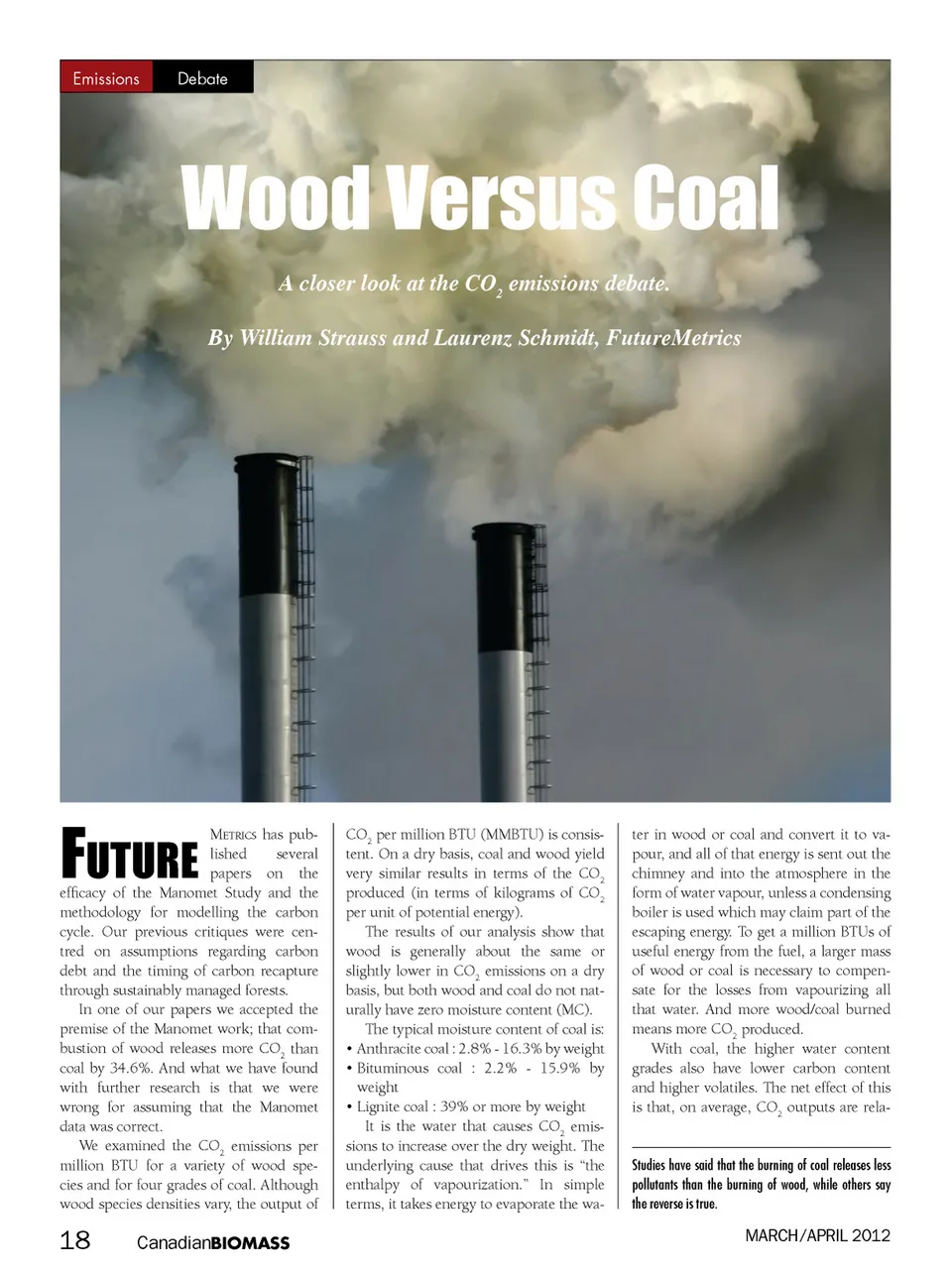
Emissions Debate Wood Versus Coal A closer look at the CO 2 emissions debate. By William Strauss and Laurenz Schmidt, FutureMetrics F uture M etrics has pub-lished several papers on the efficacy of the Manomet Study and the methodology for modelling the carbon cycle. Our previous critiques were cen-tred on assumptions regarding carbon debt and the timing of carbon recapture through sustainably managed forests. In one of our papers we accepted the premise of the Manomet work; that com-bustion of wood releases more CO 2 than coal by 34.6%. And what we have found with further research is that we were wrong for assuming that the Manomet data was correct. We examined the CO 2 emissions per million BTU for a variety of wood spe-cies and for four grades of coal. Although wood species densities vary, the output of CO 2 per million BTU (MMBTU) is consis-tent. On a dry basis, coal and wood yield very similar results in terms of the CO 2 produced (in terms of kilograms of CO 2 per unit of potential energy). The results of our analysis show that wood is generally about the same or slightly lower in CO 2 emissions on a dry basis, but both wood and coal do not nat-urally have zero moisture content (MC). The typical moisture content of coal is: • Anthracite coal : 2.8% -16.3% by weight • Bituminous coal : 2.2% -15.9% by weight • Lignite coal : 39% or more by weight It is the water that causes CO 2 emis-sions to increase over the dry weight. The underlying cause that drives this is “the enthalpy of vapourization.” In simple terms, it takes energy to evaporate the wa-ter in wood or coal and convert it to va-pour, and all of that energy is sent out the chimney and into the atmosphere in the form of water vapour, unless a condensing boiler is used which may claim part of the escaping energy. To get a million BTUs of useful energy from the fuel, a larger mass of wood or coal is necessary to compen-sate for the losses from vapourizing all that water. And more wood/coal burned means more CO 2 produced. With coal, the higher water content grades also have lower carbon content and higher volatiles. The net effect of this is that, on average, CO 2 outputs are rela-Studies have said that the burning of coal releases less pollutants than the burning of wood, while others say the reverse is true. MARCH/APRIL 2012 18 Canadian BIOMASS
Canadian Biomass March/April 2012: Page 18