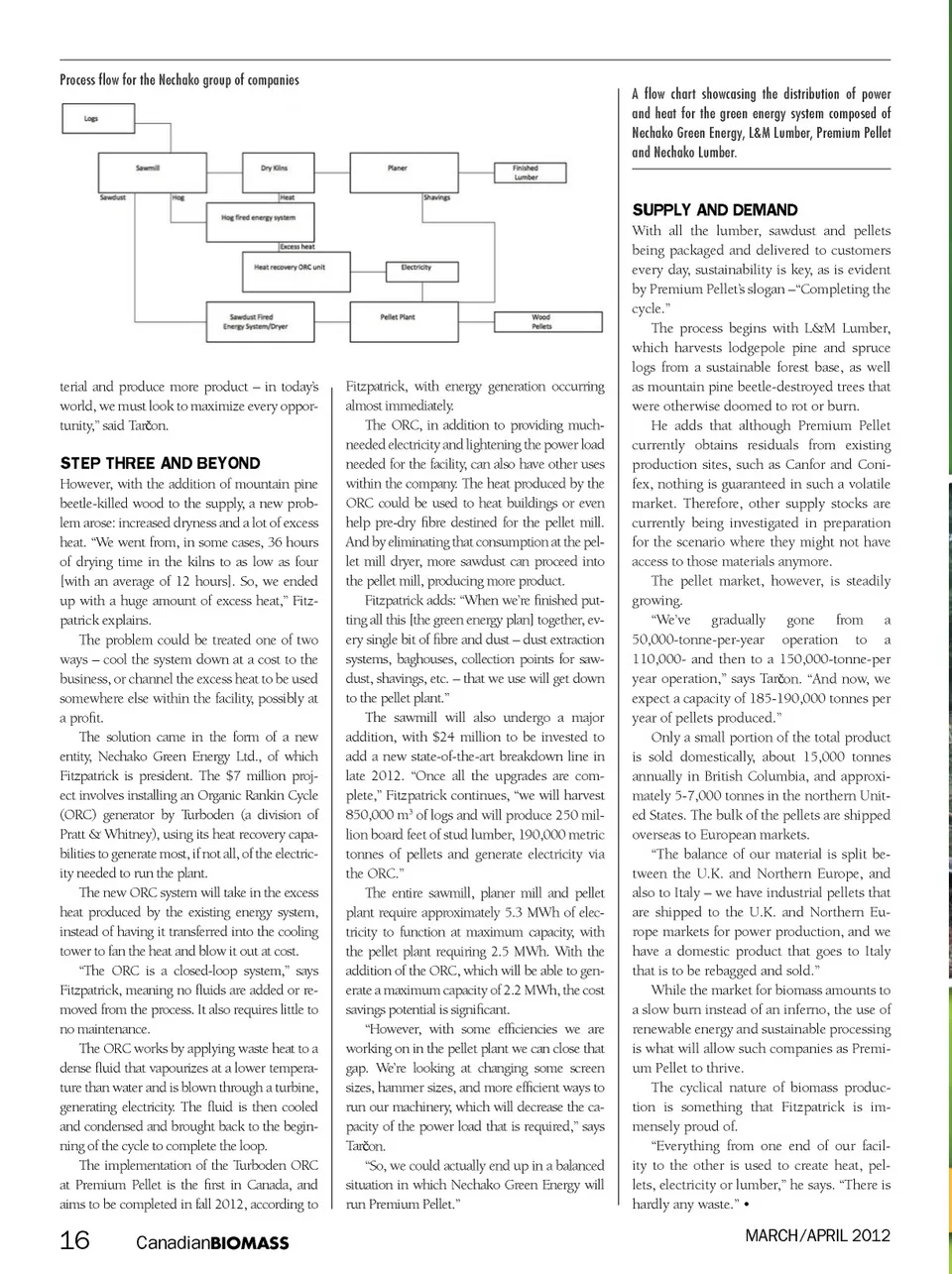
Process flow for the Nechako group of companies A flow chart showcasing the distribution of power and heat for the green energy system composed of Nechako Green Energy, L&M Lumber, Premium Pellet and Nechako Lumber. terial and produce more product – in today’s world, we must look to maximize every oppor-tunity,” said Tar on. step three and Beyond However, with the addition of mountain pine beetle-killed wood to the supply, a new prob-lem arose: increased dryness and a lot of excess heat. “We went from, in some cases, 36 hours of drying time in the kilns to as low as four [with an average of 12 hours]. So, we ended up with a huge amount of excess heat,” Fitz-patrick explains. The problem could be treated one of two ways – cool the system down at a cost to the business, or channel the excess heat to be used somewhere else within the facility, possibly at a profit. The solution came in the form of a new entity, Nechako Green Energy Ltd., of which Fitzpatrick is president. The $7 million proj-ect involves installing an Organic Rankin Cycle (ORC) generator by Turboden (a division of Pratt & Whitney), using its heat recovery capa-bilities to generate most, if not all, of the electric-ity needed to run the plant. The new ORC system will take in the excess heat produced by the existing energy system, instead of having it transferred into the cooling tower to fan the heat and blow it out at cost. “The ORC is a closed-loop system,” says Fitzpatrick, meaning no fluids are added or re-moved from the process. It also requires little to no maintenance. The ORC works by applying waste heat to a dense fluid that vapourizes at a lower tempera-ture than water and is blown through a turbine, generating electricity. The fluid is then cooled and condensed and brought back to the begin-ning of the cycle to complete the loop. The implementation of the Turboden ORC at Premium Pellet is the first in Canada, and aims to be completed in fall 2012, according to Fitzpatrick, with energy generation occurring almost immediately. The ORC, in addition to providing much-needed electricity and lightening the power load needed for the facility, can also have other uses within the company. The heat produced by the ORC could be used to heat buildings or even help pre-dry fibre destined for the pellet mill. And by eliminating that consumption at the pel-let mill dryer, more sawdust can proceed into the pellet mill, producing more product. Fitzpatrick adds: “When we’re finished put-ting all this [the green energy plan] together, ev-ery single bit of fibre and dust – dust extraction systems, baghouses, collection points for saw-dust, shavings, etc. – that we use will get down to the pellet plant.” The sawmill will also undergo a major addition, with $24 million to be invested to add a new state-of-the-art breakdown line in late 2012. “Once all the upgrades are com-plete,” Fitzpatrick continues, “we will harvest 850,000 m 3 of logs and will produce 250 mil-lion board feet of stud lumber, 190,000 metric tonnes of pellets and generate electricity via the ORC.” The entire sawmill, planer mill and pellet plant require approximately 5.3 MWh of elec-tricity to function at maximum capacity, with the pellet plant requiring 2.5 MWh. With the addition of the ORC, which will be able to gen-erate a maximum capacity of 2.2 MWh, the cost savings potential is significant. “However, with some efficiencies we are working on in the pellet plant we can close that gap. We’re looking at changing some screen sizes, hammer sizes, and more efficient ways to run our machinery, which will decrease the ca-pacity of the power load that is required,” says Tar on. “So, we could actually end up in a balanced situation in which Nechako Green Energy will run Premium Pellet.” supply and demand With all the lumber, sawdust and pellets being packaged and delivered to customers every day, sustainability is key, as is evident by Premium Pellet’s slogan –“Completing the cycle.” The process begins with L&M Lumber, which harvests lodgepole pine and spruce logs from a sustainable forest base, as well as mountain pine beetle-destroyed trees that were otherwise doomed to rot or burn. He adds that although Premium Pellet currently obtains residuals from existing production sites, such as Canfor and Coni-fex, nothing is guaranteed in such a volatile market. Therefore, other supply stocks are currently being investigated in preparation for the scenario where they might not have access to those materials anymore. The pellet market, however, is steadily growing. “We’ve gradually gone from a 50,000-tonne-per-year operation to a 110,000-and then to a 150,000-tonne-per year operation,” says Tar on. “And now, we expect a capacity of 185-190,000 tonnes per year of pellets produced.” Only a small portion of the total product is sold domestically, about 15,000 tonnes annually in British Columbia, and approxi-mately 5-7,000 tonnes in the northern Unit-ed States. The bulk of the pellets are shipped overseas to European markets. “The balance of our material is split be-tween the U.K. and Northern Europe, and also to Italy – we have industrial pellets that are shipped to the U.K. and Northern Eu-rope markets for power production, and we have a domestic product that goes to Italy that is to be rebagged and sold.” While the market for biomass amounts to a slow burn instead of an inferno, the use of renewable energy and sustainable processing is what will allow such companies as Premi-um Pellet to thrive. The cyclical nature of biomass produc-tion is something that Fitzpatrick is im-mensely proud of. “Everything from one end of our facil-ity to the other is used to create heat, pel-lets, electricity or lumber,” he says. “There is hardly any waste.” • MARCH/APRIL 2012 16 Canadian BIOMASS
Canadian Biomass March/April 2012: Page 16