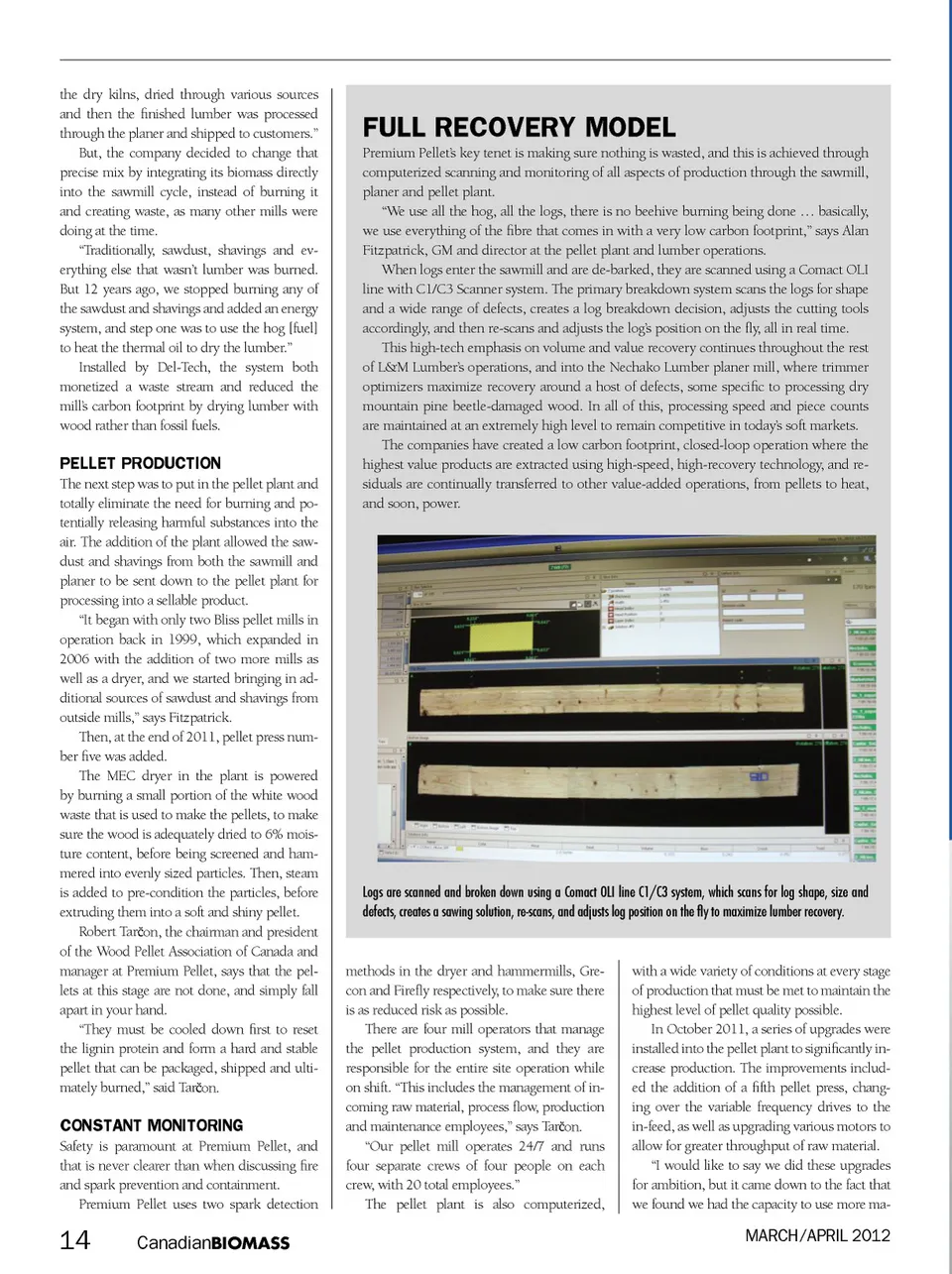
the dry kilns, dried through various sources and then the finished lumber was processed through the planer and shipped to customers.” But, the company decided to change that precise mix by integrating its biomass directly into the sawmill cycle, instead of burning it and creating waste, as many other mills were doing at the time. “Traditionally, sawdust, shavings and ev-erything else that wasn’t lumber was burned. But 12 years ago, we stopped burning any of the sawdust and shavings and added an energy system, and step one was to use the hog [fuel] to heat the thermal oil to dry the lumber.” Installed by Del-Tech, the system both monetized a waste stream and reduced the mill’s carbon footprint by drying lumber with wood rather than fossil fuels. pellet production The next step was to put in the pellet plant and totally eliminate the need for burning and po-tentially releasing harmful substances into the air. The addition of the plant allowed the saw-dust and shavings from both the sawmill and planer to be sent down to the pellet plant for processing into a sellable product. “It began with only two Bliss pellet mills in operation back in 1999, which expanded in 2006 with the addition of two more mills as well as a dryer, and we started bringing in ad-ditional sources of sawdust and shavings from outside mills,” says Fitzpatrick. Then, at the end of 2011, pellet press num-ber five was added. The MEC dryer in the plant is powered by burning a small portion of the white wood waste that is used to make the pellets, to make sure the wood is adequately dried to 6% mois-ture content, before being screened and ham-mered into evenly sized particles. Then, steam is added to pre-condition the particles, before extruding them into a soft and shiny pellet. Robert Tar on, the chairman and president of the Wood Pellet Association of Canada and manager at Premium Pellet, says that the pel-lets at this stage are not done, and simply fall apart in your hand. “They must be cooled down first to reset the lignin protein and form a hard and stable pellet that can be packaged, shipped and ulti-mately burned,” said Tar on. constant monitoring Safety is paramount at Premium Pellet, and that is never clearer than when discussing fire and spark prevention and containment. Premium Pellet uses two spark detection full recovery model Premium Pellet’s key tenet is making sure nothing is wasted, and this is achieved through computerized scanning and monitoring of all aspects of production through the sawmill, planer and pellet plant. “We use all the hog, all the logs, there is no beehive burning being done … basically, we use everything of the fibre that comes in with a very low carbon footprint,” says Alan Fitzpatrick, GM and director at the pellet plant and lumber operations. When logs enter the sawmill and are de-barked, they are scanned using a Comact OLI line with C1/C3 Scanner system. The primary breakdown system scans the logs for shape and a wide range of defects, creates a log breakdown decision, adjusts the cutting tools accordingly, and then re-scans and adjusts the log’s position on the fly, all in real time. This high-tech emphasis on volume and value recovery continues throughout the rest of L&M Lumber’s operations, and into the Nechako Lumber planer mill, where trimmer optimizers maximize recovery around a host of defects, some specific to processing dry mountain pine beetle-damaged wood. In all of this, processing speed and piece counts are maintained at an extremely high level to remain competitive in today’s soft markets. The companies have created a low carbon footprint, closed-loop operation where the highest value products are extracted using high-speed, high-recovery technology, and re-siduals are continually transferred to other value-added operations, from pellets to heat, and soon, power. Logs are scanned and broken down using a Comact OLI line C1/C3 system, which scans for log shape, size and defects, creates a sawing solution, re-scans, and adjusts log position on the fly to maximize lumber recovery. methods in the dryer and hammermills, Gre-con and Firefly respectively, to make sure there is as reduced risk as possible. There are four mill operators that manage the pellet production system, and they are responsible for the entire site operation while on shift. “This includes the management of in-coming raw material, process flow, production and maintenance employees,” says Tar on. “Our pellet mill operates 24/7 and runs four separate crews of four people on each crew, with 20 total employees.” The pellet plant is also computerized, with a wide variety of conditions at every stage of production that must be met to maintain the highest level of pellet quality possible. In October 2011, a series of upgrades were installed into the pellet plant to significantly in-crease production. The improvements includ-ed the addition of a fifth pellet press, chang-ing over the variable frequency drives to the in-feed, as well as upgrading various motors to allow for greater throughput of raw material. “I would like to say we did these upgrades for ambition, but it came down to the fact that we found we had the capacity to use more ma-MARCH/APRIL 2012 14 Canadian BIOMASS
Canadian Biomass March/April 2012: Page 14