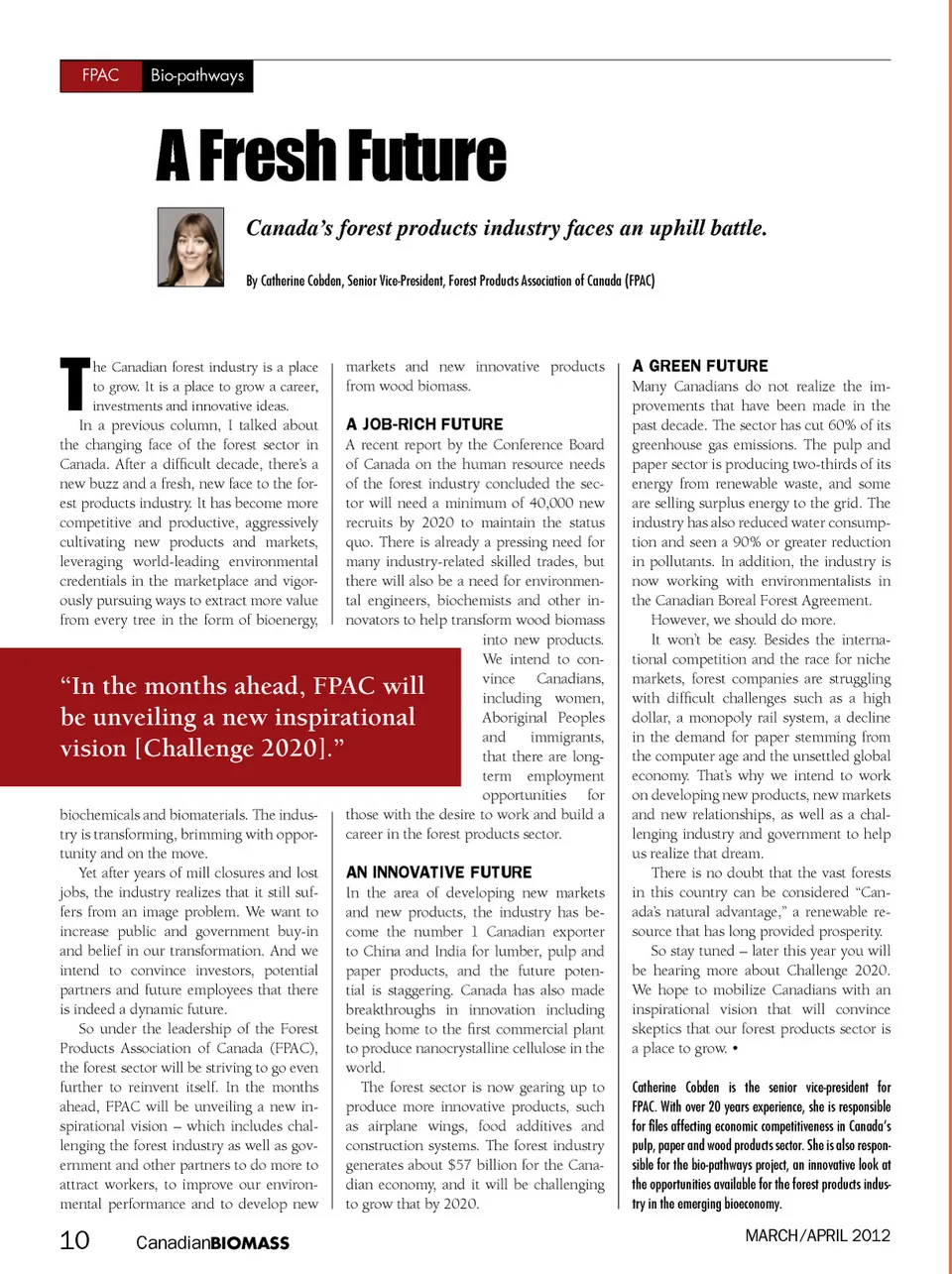
FPAC Bio-pathways A Fresh Future Canada’s forest products industry faces an uphill battle. By Catherine Cobden, Senior Vice-President, Forest Products Association of Canada (FPAC) In a previous column, I talked about the changing face of the forest sector in Canada. After a difficult decade, there’s a new buzz and a fresh, new face to the for-est products industry. It has become more competitive and productive, aggressively cultivating new products and markets, leveraging world-leading environmental credentials in the marketplace and vigor-ously pursuing ways to extract more value from every tree in the form of bioenergy, T he Canadian forest industry is a place to grow. It is a place to grow a career, investments and innovative ideas. markets and new innovative products from wood biomass. a JoB-rich future a green future “In the months ahead, FPAC will be unveiling a new inspirational vision [Challenge 2020].” biochemicals and biomaterials. The indus-try is transforming, brimming with oppor-tunity and on the move. Yet after years of mill closures and lost jobs, the industry realizes that it still suf-fers from an image problem. We want to increase public and government buy-in and belief in our transformation. And we intend to convince investors, potential partners and future employees that there is indeed a dynamic future. So under the leadership of the Forest Products Association of Canada (FPAC), the forest sector will be striving to go even further to reinvent itself. In the months ahead, FPAC will be unveiling a new in-spirational vision – which includes chal-lenging the forest industry as well as gov-ernment and other partners to do more to attract workers, to improve our environ-mental performance and to develop new A recent report by the Conference Board of Canada on the human resource needs of the forest industry concluded the sec-tor will need a minimum of 40,000 new recruits by 2020 to maintain the status quo. There is already a pressing need for many industry-related skilled trades, but there will also be a need for environmen-tal engineers, biochemists and other in-novators to help transform wood biomass into new products. We intend to con-vince Canadians, including women, Aboriginal Peoples and immigrants, that there are long-term employment opportunities for those with the desire to work and build a career in the forest products sector. an innovative future In the area of developing new markets and new products, the industry has be-come the number 1 Canadian exporter to China and India for lumber, pulp and paper products, and the future poten-tial is staggering. Canada has also made breakthroughs in innovation including being home to the first commercial plant to produce nanocrystalline cellulose in the world. The forest sector is now gearing up to produce more innovative products, such as airplane wings, food additives and construction systems. The forest industry generates about $57 billion for the Cana-dian economy, and it will be challenging to grow that by 2020. Many Canadians do not realize the im-provements that have been made in the past decade. The sector has cut 60% of its greenhouse gas emissions. The pulp and paper sector is producing two-thirds of its energy from renewable waste, and some are selling surplus energy to the grid. The industry has also reduced water consump-tion and seen a 90% or greater reduction in pollutants. In addition, the industry is now working with environmentalists in the Canadian Boreal Forest Agreement. However, we should do more. It won’t be easy. Besides the interna-tional competition and the race for niche markets, forest companies are struggling with difficult challenges such as a high dollar, a monopoly rail system, a decline in the demand for paper stemming from the computer age and the unsettled global economy. That’s why we intend to work on developing new products, new markets and new relationships, as well as a chal-lenging industry and government to help us realize that dream. There is no doubt that the vast forests in this country can be considered “Can-ada’s natural advantage,” a renewable re-source that has long provided prosperity. So stay tuned – later this year you will be hearing more about Challenge 2020. We hope to mobilize Canadians with an inspirational vision that will convince skeptics that our forest products sector is a place to grow. • Catherine Cobden is the senior vice-president for FPAC. With over 20 years experience, she is responsible for files affecting economic competitiveness in Canada’s pulp, paper and wood products sector. She is also respon-sible for the bio-pathways project, an innovative look at the opportunities available for the forest products indus-try in the emerging bioeconomy. MARCH/APRIL 2012 10 Canadian BIOMASS
Canadian Biomass March/April 2012: Page 10