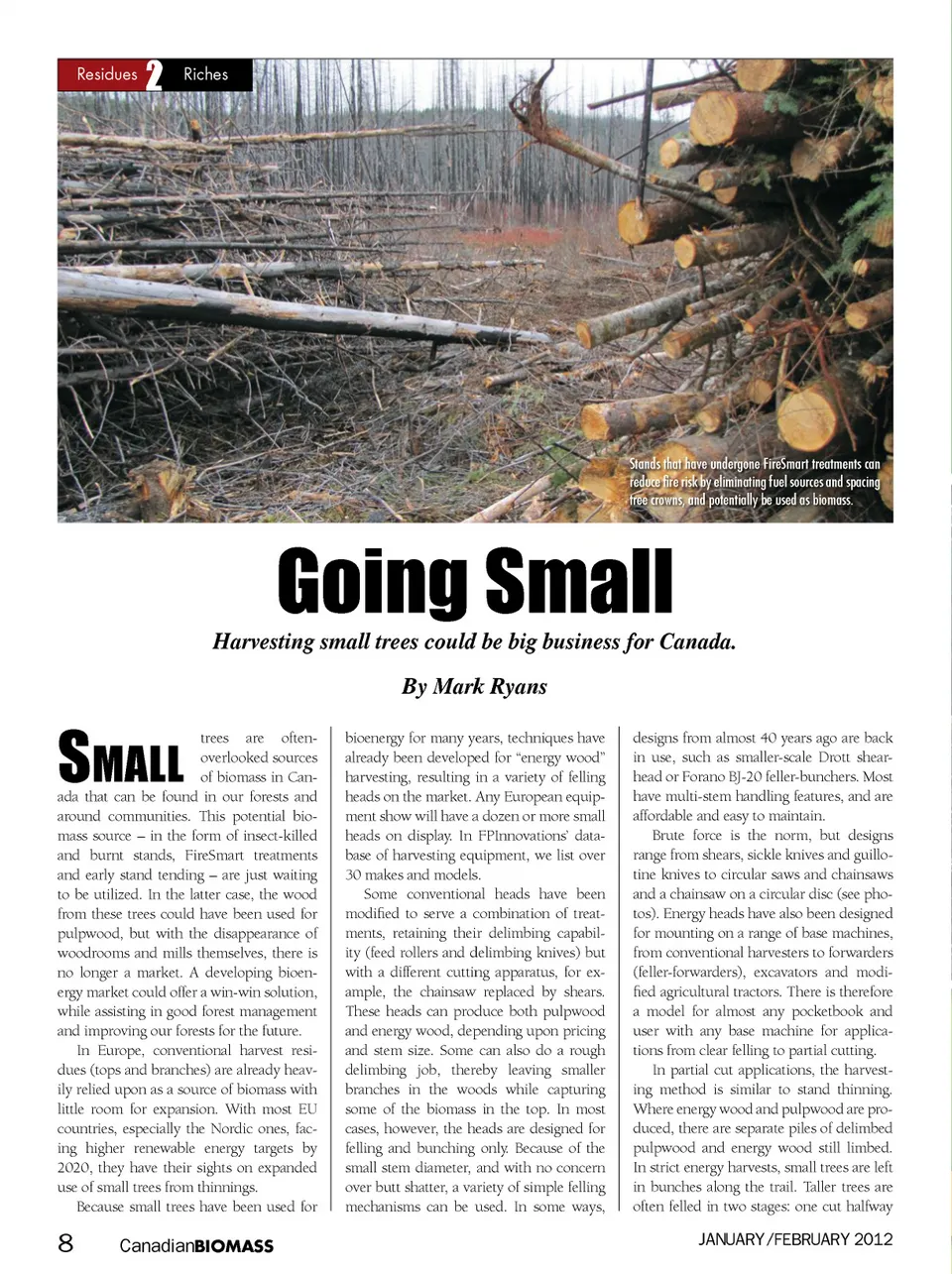
Residues 2 Riches Stands that have undergone FireSmart treatments can reduce fire risk by eliminating fuel sources and spacing tree crowns, and potentially be used as biomass. Harvesting small trees could be big business for Canada. By Mark Ryans trees are often-overlooked sources of biomass in Can-ada that can be found in our forests and around communities. This potential bio-mass source – in the form of insect-killed and burnt stands, FireSmart treatments and early stand tending – are just waiting to be utilized. In the latter case, the wood from these trees could have been used for pulpwood, but with the disappearance of woodrooms and mills themselves, there is no longer a market. A developing bioen-ergy market could offer a win-win solution, while assisting in good forest management and improving our forests for the future. In Europe, conventional harvest resi-dues (tops and branches) are already heav-ily relied upon as a source of biomass with little room for expansion. With most EU countries, especially the Nordic ones, fac-ing higher renewable energy targets by 2020, they have their sights on expanded use of small trees from thinnings. Because small trees have been used for Going Small bioenergy for many years, techniques have already been developed for “energy wood” harvesting, resulting in a variety of felling heads on the market. Any European equip-ment show will have a dozen or more small heads on display. In FPInnovations’ data-base of harvesting equipment, we list over 30 makes and models. Some conventional heads have been modified to serve a combination of treat-ments, retaining their delimbing capabil-ity (feed rollers and delimbing knives) but with a different cutting apparatus, for ex-ample, the chainsaw replaced by shears. These heads can produce both pulpwood and energy wood, depending upon pricing and stem size. Some can also do a rough delimbing job, thereby leaving smaller branches in the woods while capturing some of the biomass in the top. In most cases, however, the heads are designed for felling and bunching only. Because of the small stem diameter, and with no concern over butt shatter, a variety of simple felling mechanisms can be used. In some ways, S mall designs from almost 40 years ago are back in use, such as smaller-scale Drott shear-head or Forano BJ-20 feller-bunchers. Most have multi-stem handling features, and are affordable and easy to maintain. Brute force is the norm, but designs range from shears, sickle knives and guillo-tine knives to circular saws and chainsaws and a chainsaw on a circular disc (see pho-tos). Energy heads have also been designed for mounting on a range of base machines, from conventional harvesters to forwarders (feller-forwarders), excavators and modi-fied agricultural tractors. There is therefore a model for almost any pocketbook and user with any base machine for applica-tions from clear felling to partial cutting. In partial cut applications, the harvest-ing method is similar to stand thinning. Where energy wood and pulpwood are pro-duced, there are separate piles of delimbed pulpwood and energy wood still limbed. In strict energy harvests, small trees are left in bunches along the trail. Taller trees are often felled in two stages: one cut halfway JANUARY/FEBRUARY 2012 8 Canadian BIOMASS
Canadian Biomass January/February 2012: Page 8