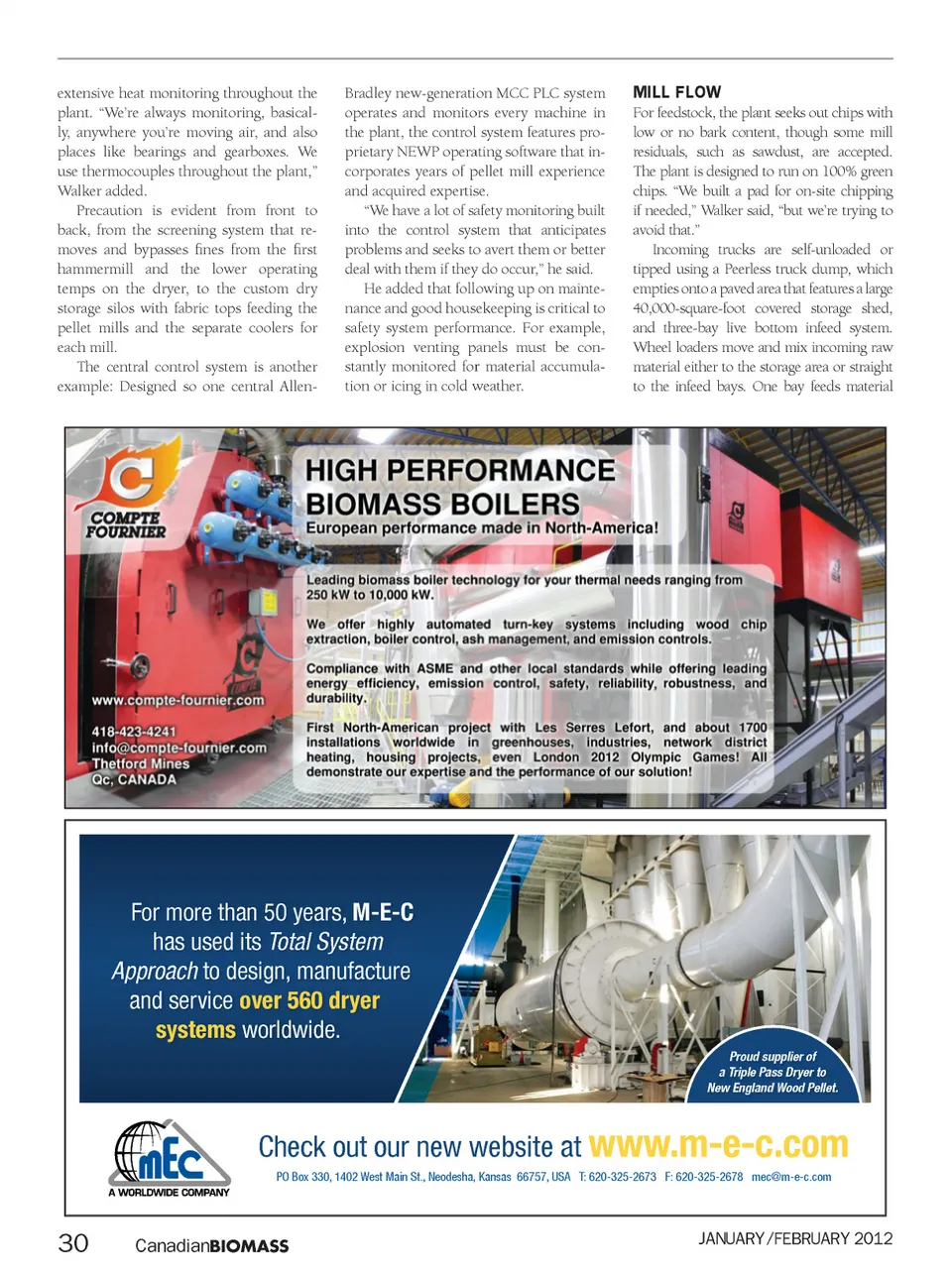
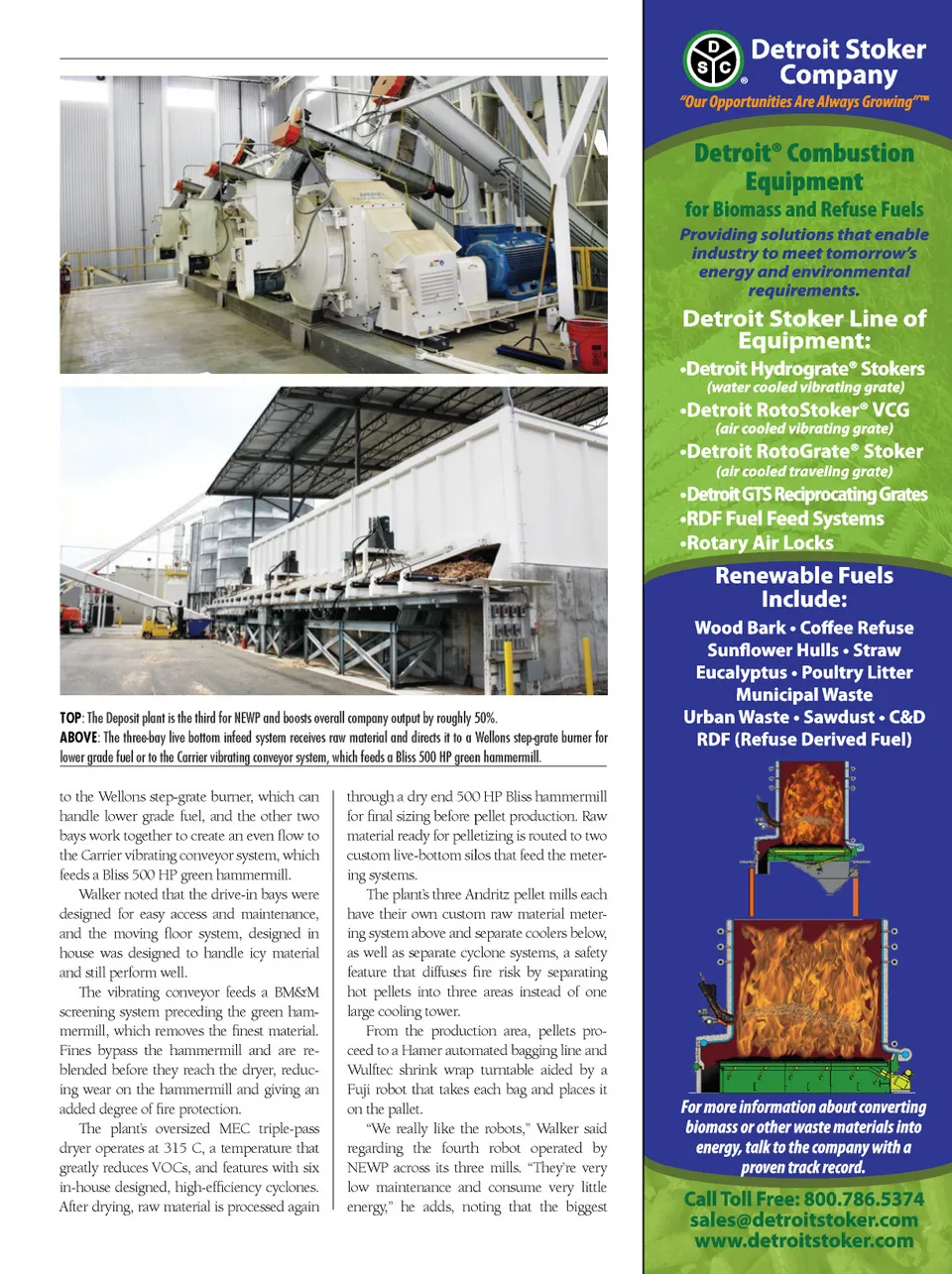
® TOP : The Deposit plant is the third for NEWP and boosts overall company output by roughly 50%. ABOVE : The three-bay live bottom infeed system receives raw material and directs it to a Wellons step-grate burner for lower grade fuel or to the Carrier vibrating conveyor system, which feeds a Bliss 500 HP green hammermill. to the Wellons step-grate burner, which can handle lower grade fuel, and the other two bays work together to create an even flow to the Carrier vibrating conveyor system, which feeds a Bliss 500 HP green hammermill. Walker noted that the drive-in bays were designed for easy access and maintenance, and the moving floor system, designed in house was designed to handle icy material and still perform well. The vibrating conveyor feeds a BM&M screening system preceding the green ham-mermill, which removes the finest material. Fines bypass the hammermill and are re-blended before they reach the dryer, reduc-ing wear on the hammermill and giving an added degree of fire protection. The plant’s oversized MEC triple-pass dryer operates at 315 C, a temperature that greatly reduces VOCs, and features with six in-house designed, high-efficiency cyclones. After drying, raw material is processed again through a dry end 500 HP Bliss hammermill for final sizing before pellet production. Raw material ready for pelletizing is routed to two custom live-bottom silos that feed the meter-ing systems. The plant’s three Andritz pellet mills each have their own custom raw material meter-ing system above and separate coolers below, as well as separate cyclone systems, a safety feature that diffuses fire risk by separating hot pellets into three areas instead of one large cooling tower. From the production area, pellets pro-ceed to a Hamer automated bagging line and Wulftec shrink wrap turntable aided by a Fuji robot that takes each bag and places it on the pallet. “We really like the robots,” Walker said regarding the fourth robot operated by NEWP across its three mills. “They’re very low maintenance and consume very little energy,” he adds, noting that the biggest
Canadian Biomass January/February 2012: Page 31