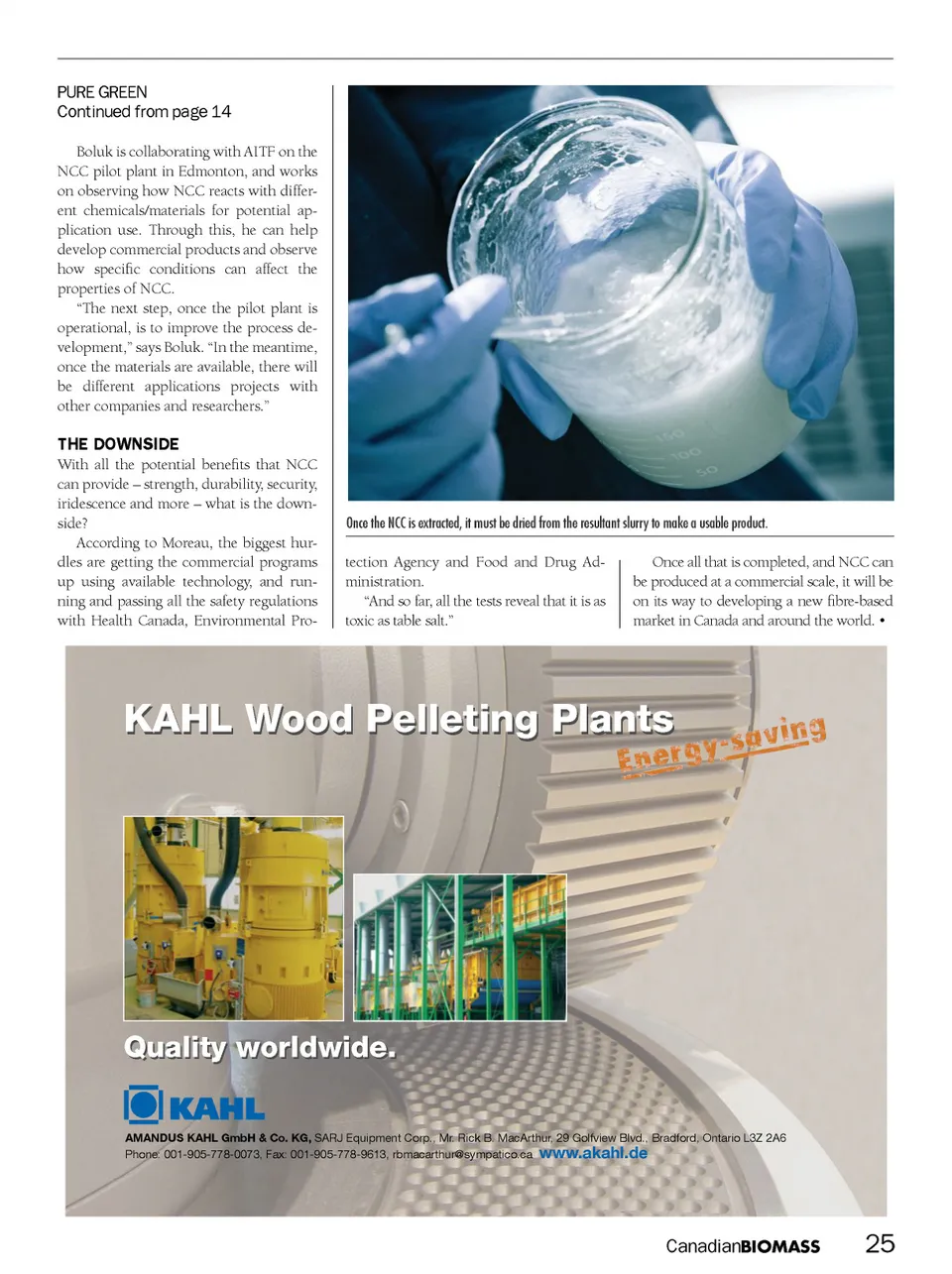
PURE GREEN Continued from page 14 Boluk is collaborating with AITF on the NCC pilot plant in Edmonton, and works on observing how NCC reacts with differ-ent chemicals/materials for potential ap-plication use. Through this, he can help develop commercial products and observe how specific conditions can affect the properties of NCC. “The next step, once the pilot plant is operational, is to improve the process de-velopment,” says Boluk. “In the meantime, once the materials are available, there will be different applications projects with other companies and researchers.” the dOWnside With all the potential benefits that NCC can provide – strength, durability, security, iridescence and more – what is the down-side? According to Moreau, the biggest hur-dles are getting the commercial programs up using available technology, and run-ning and passing all the safety regulations with Health Canada, Environmental Pro-Once the NCC is extracted, it must be dried from the resultant slurry to make a usable product. tection Agency and Food and Drug Ad-ministration. “And so far, all the tests reveal that it is as toxic as table salt.” Once all that is completed, and NCC can be produced at a commercial scale, it will be on its way to developing a new fibre-based market in Canada and around the world. • KAHL Wood Pelleting Plants Quality worldwide. AMANDUS KAHL GmbH & Co. KG, SARJ Equipment Corp., Mr. Rick B. MacArthur, 29 Golfview Blvd., Bradford, Ontario L3Z 2A6 Phone: 001-905-778-0073, Fax: 001-905-778-9613, [email protected] www.akahl.de Canadian BIOMASS 25
Canadian Biomass January/February 2012: Page 25