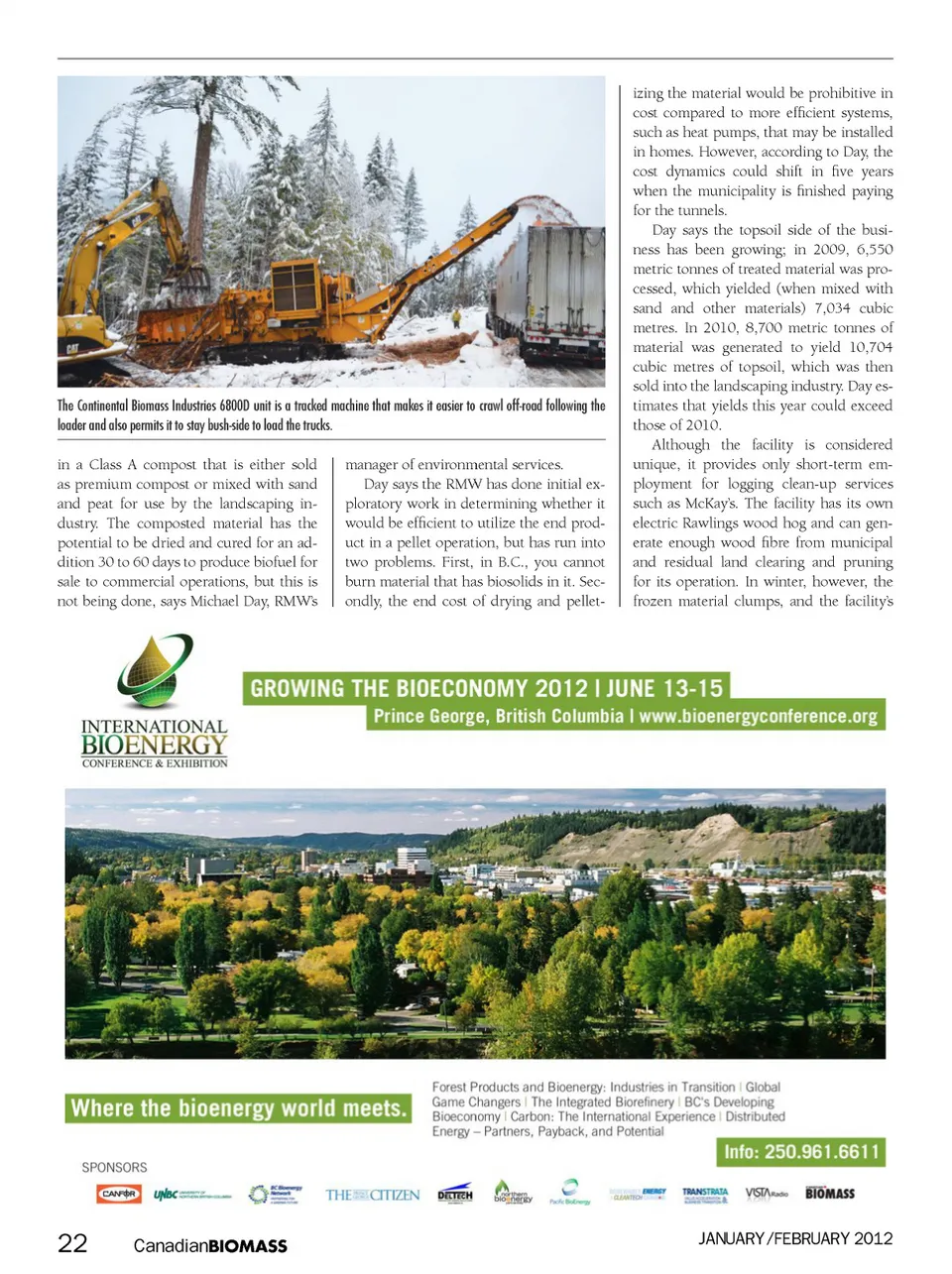
grinders are not able to handle it, says McKay. But, he can grind the biomass from his forest woodlot to keep the facility going all winter in just a few days. McKay’s CBI grinder will soon move to a Richmond landfill, where he will be grinding waste wood for a company that makes topsoil. The work that exists in the Coast regions is fairly spotty, and for operators like McKay, it is not enough to foster growth. But that was not always the case. Triack was set to grind forest biomass for Howe Sound Pulp and Paper (HSPP) but the pulp mill’s older boiler suffered problems and was no longer able to handle the grit and dirt until a new unit was installed. In the meantime, it sought cleaner and drier feedstock from moun-tain pine beetle-damaged mill residuals and construction waste wood from the Lower Mainland. Triack has now completed a new boil-er upgrade, part of a $37-million federal Green Transformation Program funding, that improves the boiler efficiency. But in 2010, HSPP and BC Hydro signed an The grinder and loader take half an hour to load the trailer, which holds more than 98 cubic metres of material. agreement that allowed HSPP to feed power back into BC Hydro’s grid. McKay says local suppliers like him lost out, as BC Hydro demanded long-term contracts to guarantee its supply in 2010. He says his company has gone from 30 employees, a barge-loading fa-cility and several trucks down to just a truck, grinder and loader. He can’t sell to companies with contracts to HSPP, as they have an abundance of product. Other existing pulp mills are in an over-supply situation, having either curtailed production or, like Elk Falls in Campell River, closed out. “The root cause of the problems in the Wood Moisture Testers You need it ? WE HAVE IT ! Annual Special Canadian BIOMASS 23
Canadian Biomass January/February 2012: Page 23