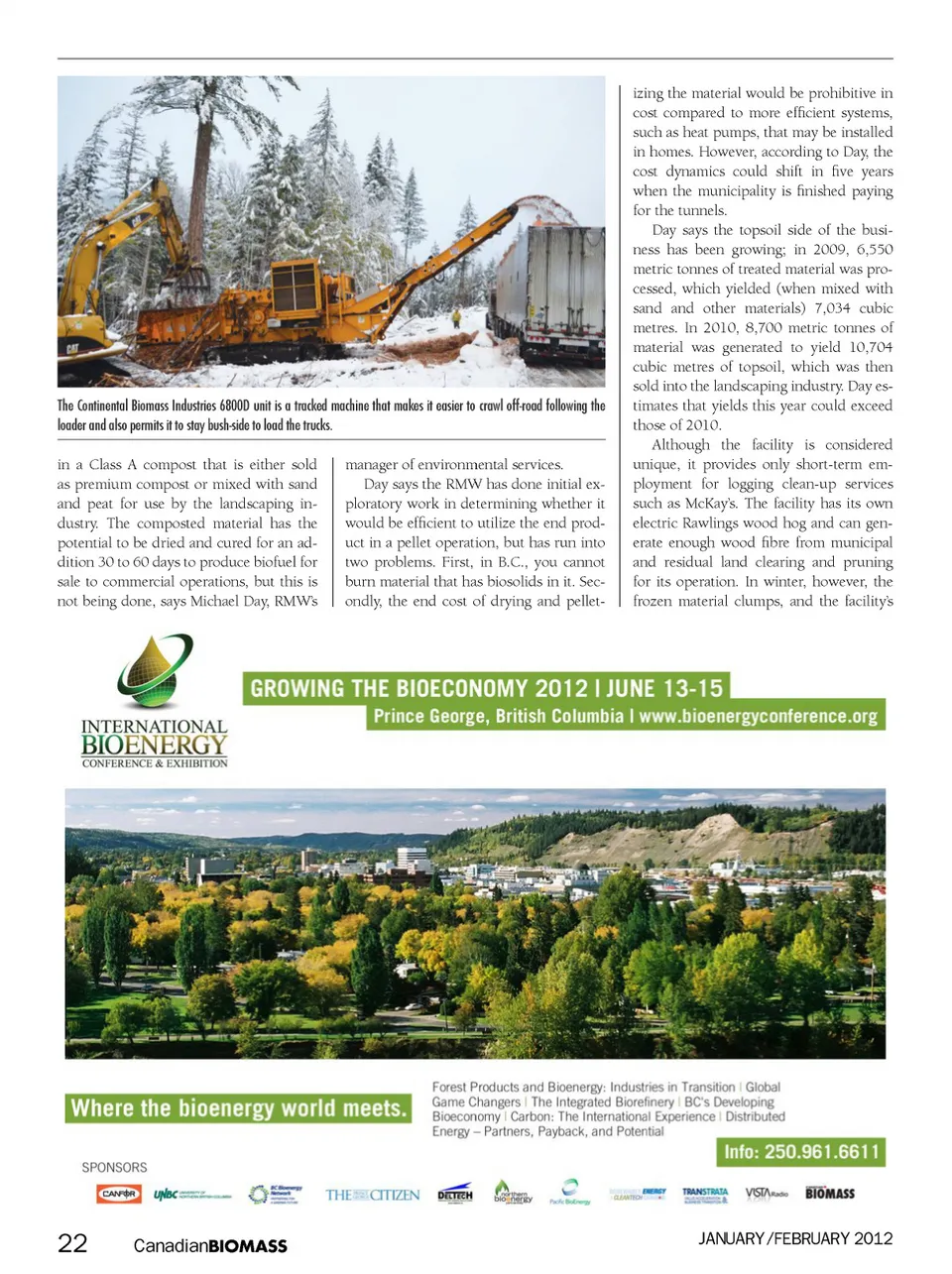
The Continental Biomass Industries 6800D unit is a tracked machine that makes it easier to crawl off-road following the loader and also permits it to stay bush-side to load the trucks. in a Class A compost that is either sold as premium compost or mixed with sand and peat for use by the landscaping in-dustry. The composted material has the potential to be dried and cured for an ad-dition 30 to 60 days to produce biofuel for sale to commercial operations, but this is not being done, says Michael Day, RMW’s manager of environmental services. Day says the RMW has done initial ex-ploratory work in determining whether it would be efficient to utilize the end prod-uct in a pellet operation, but has run into two problems. First, in B.C., you cannot burn material that has biosolids in it. Sec-ondly, the end cost of drying and pellet-izing the material would be prohibitive in cost compared to more efficient systems, such as heat pumps, that may be installed in homes. However, according to Day, the cost dynamics could shift in five years when the municipality is finished paying for the tunnels. Day says the topsoil side of the busi-ness has been growing; in 2009, 6,550 metric tonnes of treated material was pro-cessed, which yielded (when mixed with sand and other materials) 7,034 cubic metres. In 2010, 8,700 metric tonnes of material was generated to yield 10,704 cubic metres of topsoil, which was then sold into the landscaping industry. Day es-timates that yields this year could exceed those of 2010. Although the facility is considered unique, it provides only short-term em-ployment for logging clean-up services such as McKay’s. The facility has its own electric Rawlings wood hog and can gen-erate enough wood fibre from municipal and residual land clearing and pruning for its operation. In winter, however, the frozen material clumps, and the facility’s 22 Canadian BIOMASS JANUARY/FEBRUARY 2012
Canadian Biomass January/February 2012: Page 22