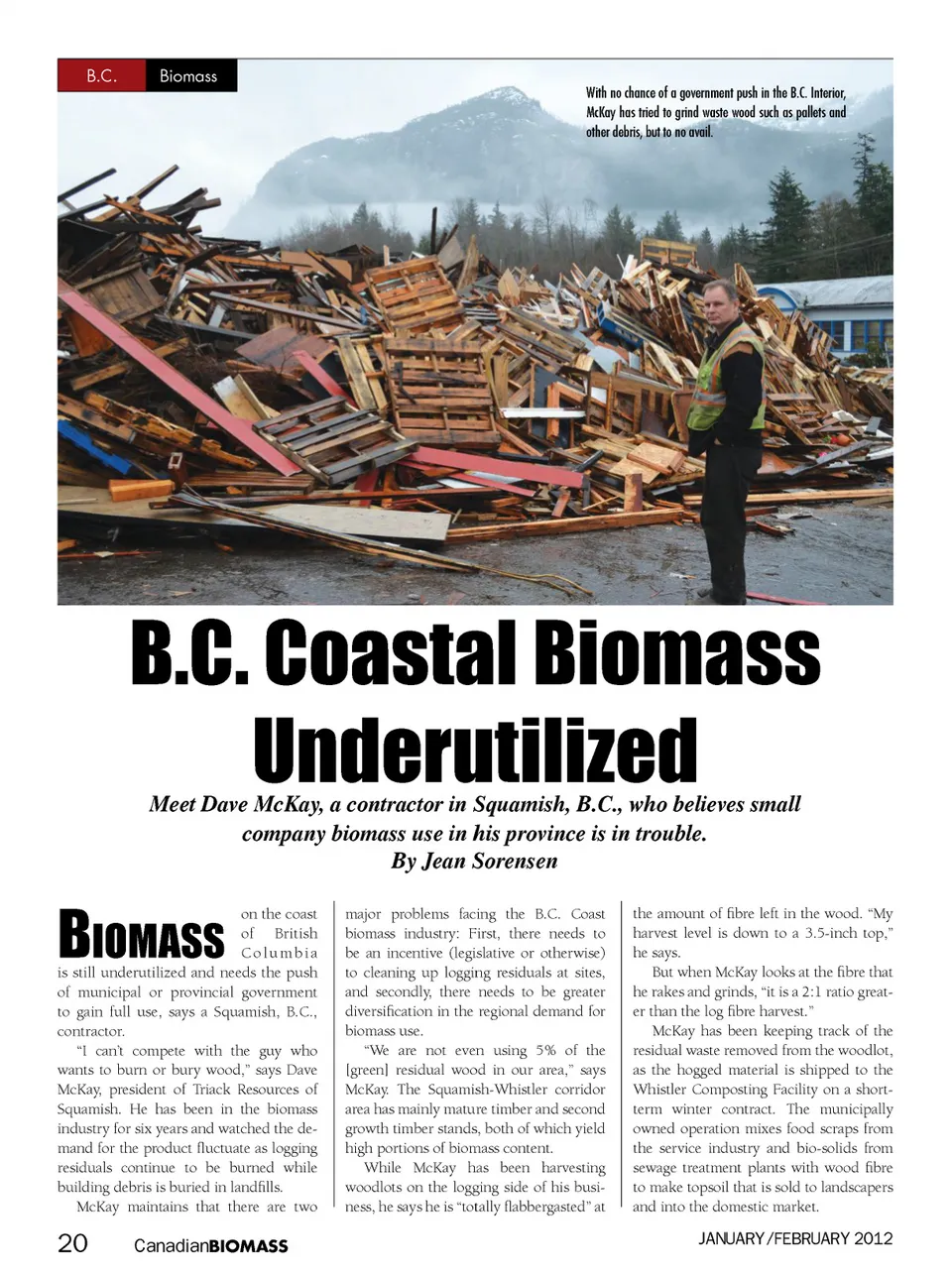
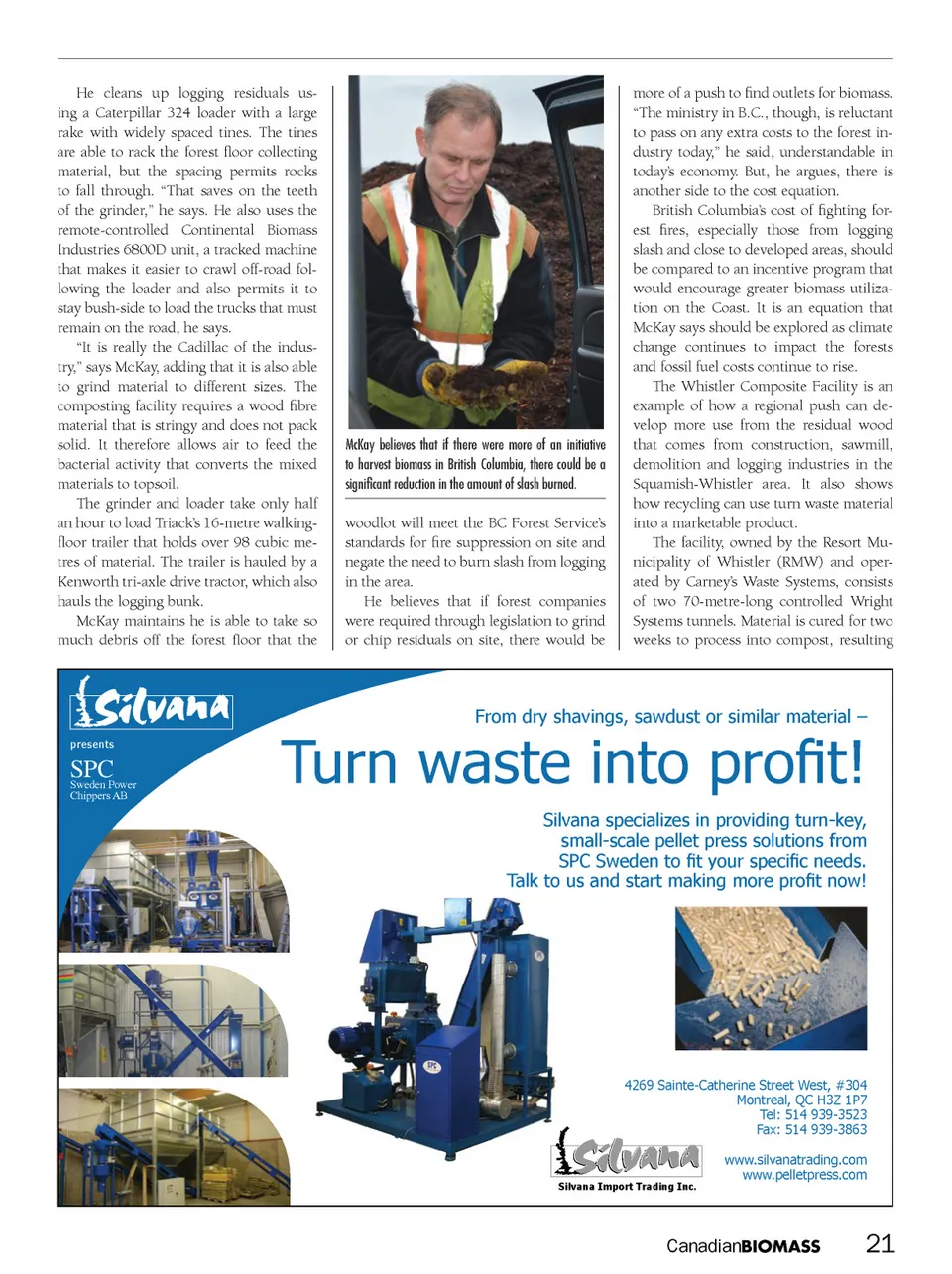
He cleans up logging residuals us-ing a Caterpillar 324 loader with a large rake with widely spaced tines. The tines are able to rack the forest floor collecting material, but the spacing permits rocks to fall through. “That saves on the teeth of the grinder,” he says. He also uses the remote-controlled Continental Biomass Industries 6800D unit, a tracked machine that makes it easier to crawl off-road fol-lowing the loader and also permits it to stay bush-side to load the trucks that must remain on the road, he says. “It is really the Cadillac of the indus-try,” says McKay, adding that it is also able to grind material to different sizes. The composting facility requires a wood fibre material that is stringy and does not pack solid. It therefore allows air to feed the bacterial activity that converts the mixed materials to topsoil. The grinder and loader take only half an hour to load Triack’s 16-metre walking-floor trailer that holds over 98 cubic me-tres of material. The trailer is hauled by a Kenworth tri-axle drive tractor, which also hauls the logging bunk. McKay maintains he is able to take so much debris off the forest floor that the McKay believes that if there were more of an initiative to harvest biomass in British Columbia, there could be a significant reduction in the amount of slash burned. woodlot will meet the BC Forest Service’s standards for fire suppression on site and negate the need to burn slash from logging in the area. He believes that if forest companies were required through legislation to grind or chip residuals on site, there would be more of a push to find outlets for biomass. “The ministry in B.C., though, is reluctant to pass on any extra costs to the forest in-dustry today,” he said, understandable in today’s economy. But, he argues, there is another side to the cost equation. British Columbia’s cost of fighting for-est fires, especially those from logging slash and close to developed areas, should be compared to an incentive program that would encourage greater biomass utiliza-tion on the Coast. It is an equation that McKay says should be explored as climate change continues to impact the forests and fossil fuel costs continue to rise. The Whistler Composite Facility is an example of how a regional push can de-velop more use from the residual wood that comes from construction, sawmill, demolition and logging industries in the Squamish-Whistler area. It also shows how recycling can use turn waste material into a marketable product. The facility, owned by the Resort Mu-nicipality of Whistler (RMW) and oper-ated by Carney’s Waste Systems, consists of two 70-metre-long controlled Wright Systems tunnels. Material is cured for two weeks to process into compost, resulting presents SPC Sweden Power Chippers AB Turn waste into profit! From dry shavings, sawdust or similar material – Silvana specializes in providing turn-key, small-scale pellet press solutions from SPC Sweden to fit your specific needs. Talk to us and start making more profit now! 4269 Sainte-Catherine Street West, #304 Montreal, QC H3Z 1P7 Tel: 514 939-3523 Fax: 514 939-3863 www.silvanatrading.com www.pelletpress.com Silvana Import Trading Inc. Canadian BIOMASS 21
Canadian Biomass January/February 2012: Page 21