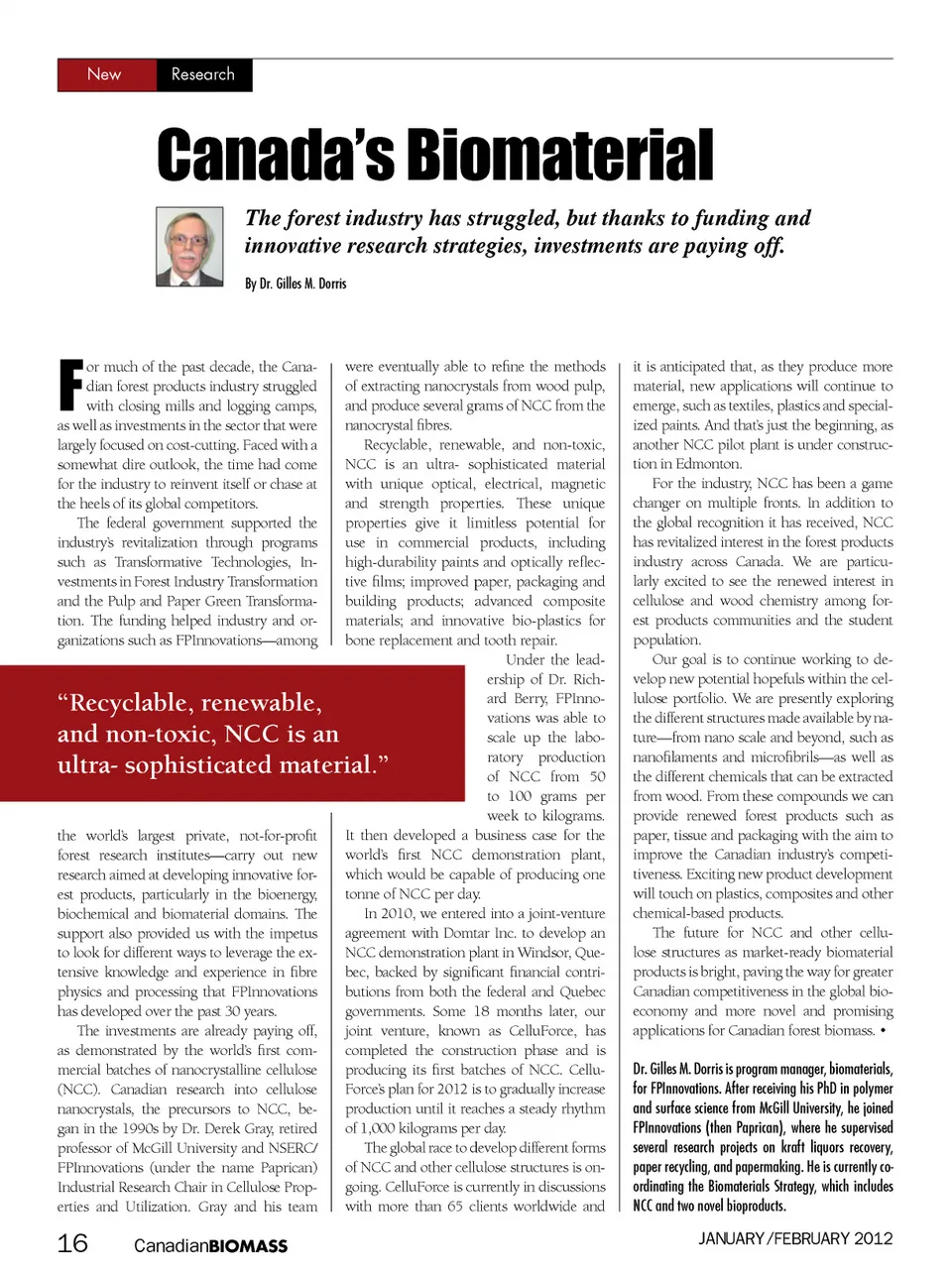
New Research Canada’s Biomaterial The forest industry has struggled, but thanks to funding and innovative research strategies, investments are paying off. By Dr. Gilles M. Dorris F or much of the past decade, the Cana-dian forest products industry struggled with closing mills and logging camps, as well as investments in the sector that were largely focused on cost-cutting. Faced with a somewhat dire outlook, the time had come for the industry to reinvent itself or chase at the heels of its global competitors. The federal government supported the industry’s revitalization through programs such as Transformative Technologies, In-vestments in Forest Industry Transformation and the Pulp and Paper Green Transforma-tion. The funding helped industry and or-ganizations such as FPInnovations—among “Recyclable, renewable, and non-toxic, NCC is an ultra-sophisticated material.” the world’s largest private, not-for-profit forest research institutes—carry out new research aimed at developing innovative for-est products, particularly in the bioenergy, biochemical and biomaterial domains. The support also provided us with the impetus to look for different ways to leverage the ex-tensive knowledge and experience in fibre physics and processing that FPInnovations has developed over the past 30 years. The investments are already paying off, as demonstrated by the world’s first com-mercial batches of nanocrystalline cellulose (NCC). Canadian research into cellulose nanocrystals, the precursors to NCC, be-gan in the 1990s by Dr. Derek Gray, retired professor of McGill University and NSERC/ FPInnovations (under the name Paprican) Industrial Research Chair in Cellulose Prop-erties and Utilization. Gray and his team were eventually able to refine the methods of extracting nanocrystals from wood pulp, and produce several grams of NCC from the nanocrystal fibres. Recyclable, renewable, and non-toxic, NCC is an ultra-sophisticated material with unique optical, electrical, magnetic and strength properties. These unique properties give it limitless potential for use in commercial products, including high-durability paints and optically reflec-tive films; improved paper, packaging and building products; advanced composite materials; and innovative bio-plastics for bone replacement and tooth repair. Under the lead-ership of Dr. Rich-ard Berry, FPInno-vations was able to scale up the labo-ratory production of NCC from 50 to 100 grams per week to kilograms. It then developed a business case for the world’s first NCC demonstration plant, which would be capable of producing one tonne of NCC per day. In 2010, we entered into a joint-venture agreement with Domtar Inc. to develop an NCC demonstration plant in Windsor, Que-bec, backed by significant financial contri-butions from both the federal and Quebec governments. Some 18 months later, our joint venture, known as CelluForce, has completed the construction phase and is producing its first batches of NCC. Cellu-Force’s plan for 2012 is to gradually increase production until it reaches a steady rhythm of 1,000 kilograms per day. The global race to develop different forms of NCC and other cellulose structures is on-going. CelluForce is currently in discussions with more than 65 clients worldwide and it is anticipated that, as they produce more material, new applications will continue to emerge, such as textiles, plastics and special-ized paints. And that’s just the beginning, as another NCC pilot plant is under construc-tion in Edmonton. For the industry, NCC has been a game changer on multiple fronts. In addition to the global recognition it has received, NCC has revitalized interest in the forest products industry across Canada. We are particu-larly excited to see the renewed interest in cellulose and wood chemistry among for-est products communities and the student population. Our goal is to continue working to de-velop new potential hopefuls within the cel-lulose portfolio. We are presently exploring the different structures made available by na-ture—from nano scale and beyond, such as nanofilaments and microfibrils—as well as the different chemicals that can be extracted from wood. From these compounds we can provide renewed forest products such as paper, tissue and packaging with the aim to improve the Canadian industry’s competi-tiveness. Exciting new product development will touch on plastics, composites and other chemical-based products. The future for NCC and other cellu-lose structures as market-ready biomaterial products is bright, paving the way for greater Canadian competitiveness in the global bio-economy and more novel and promising applications for Canadian forest biomass. • Dr. Gilles M. Dorris is program manager, biomaterials, for FPInnovations. After receiving his PhD in polymer and surface science from McGill University, he joined FPInnovations (then Paprican), where he supervised several research projects on kraft liquors recovery, paper recycling, and papermaking. He is currently co-ordinating the Biomaterials Strategy, which includes NCC and two novel bioproducts. JANUARY/FEBRUARY 2012 16 Canadian BIOMASS
Canadian Biomass January/February 2012: Page 16