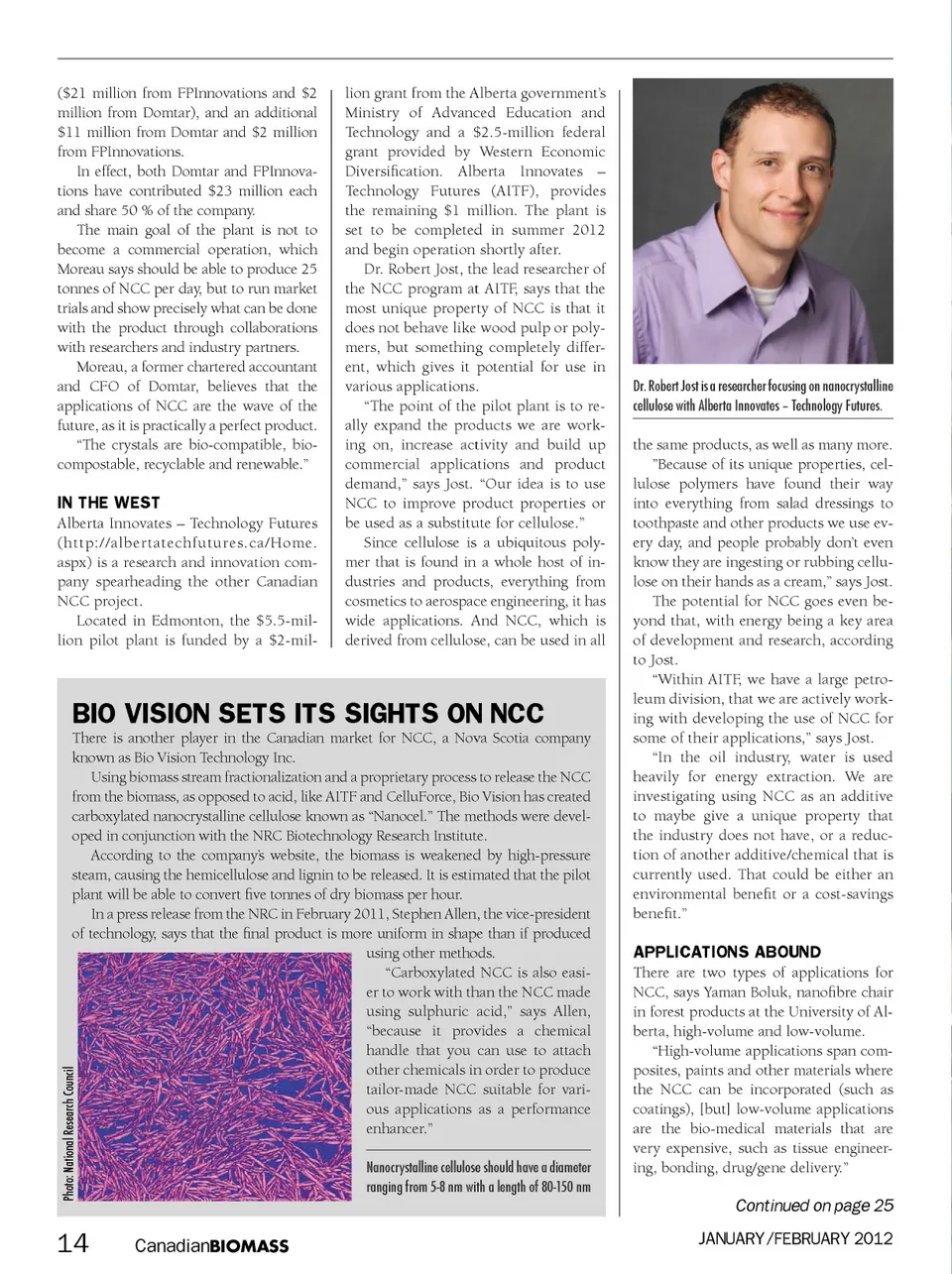
($21 million from FPInnovations and $2 million from Domtar), and an additional $11 million from Domtar and $2 million from FPInnovations. In effect, both Domtar and FPInnova-tions have contributed $23 million each and share 50 % of the company. The main goal of the plant is not to become a commercial operation, which Moreau says should be able to produce 25 tonnes of NCC per day, but to run market trials and show precisely what can be done with the product through collaborations with researchers and industry partners. Moreau, a former chartered accountant and CFO of Domtar, believes that the applications of NCC are the wave of the future, as it is practically a perfect product. “The crystals are bio-compatible, bio-compostable, recyclable and renewable.” in the West Alberta Innovates – Technology Futures (http://albertatechfutures.ca/Home. aspx) is a research and innovation com-pany spearheading the other Canadian NCC project. Located in Edmonton, the $5.5-mil-lion pilot plant is funded by a $2-mil-lion grant from the Alberta government’s Ministry of Advanced Education and Technology and a $2.5-million federal grant provided by Western Economic Diversification. Alberta Innovates – Technology Futures (AITF), provides the remaining $1 million. The plant is set to be completed in summer 2012 and begin operation shortly after. Dr. Robert Jost, the lead researcher of the NCC program at AITF, says that the most unique property of NCC is that it does not behave like wood pulp or poly-mers, but something completely differ-ent, which gives it potential for use in various applications. “The point of the pilot plant is to re-ally expand the products we are work-ing on, increase activity and build up commercial applications and product demand,” says Jost. “Our idea is to use NCC to improve product properties or be used as a substitute for cellulose.” Since cellulose is a ubiquitous poly-mer that is found in a whole host of in-dustries and products, everything from cosmetics to aerospace engineering, it has wide applications. And NCC, which is derived from cellulose, can be used in all Dr. Robert Jost is a researcher focusing on nanocrystalline cellulose with Alberta Innovates – Technology Futures. biO visiOn sets its sights On ncc There is another player in the Canadian market for NCC, a Nova Scotia company known as Bio Vision Technology Inc. Using biomass stream fractionalization and a proprietary process to release the NCC from the biomass, as opposed to acid, like AITF and CelluForce, Bio Vision has created carboxylated nanocrystalline cellulose known as “Nanocel.” The methods were devel-oped in conjunction with the NRC Biotechnology Research Institute. According to the company’s website, the biomass is weakened by high-pressure steam, causing the hemicellulose and lignin to be released. It is estimated that the pilot plant will be able to convert five tonnes of dry biomass per hour. In a press release from the NRC in February 2011, Stephen Allen, the vice-president of technology, says that the final product is more uniform in shape than if produced using other methods. “Carboxylated NCC is also easi-er to work with than the NCC made using sulphuric acid,” says Allen, “because it provides a chemical handle that you can use to attach other chemicals in order to produce tailor-made NCC suitable for vari-ous applications as a performance enhancer.” Nanocrystalline cellulose should have a diameter ranging from 5-8 nm with a length of 80-150 nm the same products, as well as many more. ”Because of its unique properties, cel-lulose polymers have found their way into everything from salad dressings to toothpaste and other products we use ev-ery day, and people probably don’t even know they are ingesting or rubbing cellu-lose on their hands as a cream,” says Jost. The potential for NCC goes even be-yond that, with energy being a key area of development and research, according to Jost. “Within AITF, we have a large petro-leum division, that we are actively work-ing with developing the use of NCC for some of their applications,” says Jost. “In the oil industry, water is used heavily for energy extraction. We are investigating using NCC as an additive to maybe give a unique property that the industry does not have, or a reduc-tion of another additive/chemical that is currently used. That could be either an environmental benefit or a cost-savings benefit.” applicatiOns abOund Photo: National Research Council There are two types of applications for NCC, says Yaman Boluk, nanofibre chair in forest products at the University of Al-berta, high-volume and low-volume. “High-volume applications span com-posites, paints and other materials where the NCC can be incorporated (such as coatings), [but] low-volume applications are the bio-medical materials that are very expensive, such as tissue engineer-ing, bonding, drug/gene delivery.” Continued on page 25 JANUARY/FEBRUARY 2012 14 Canadian BIOMASS
Canadian Biomass January/February 2012: Page 14