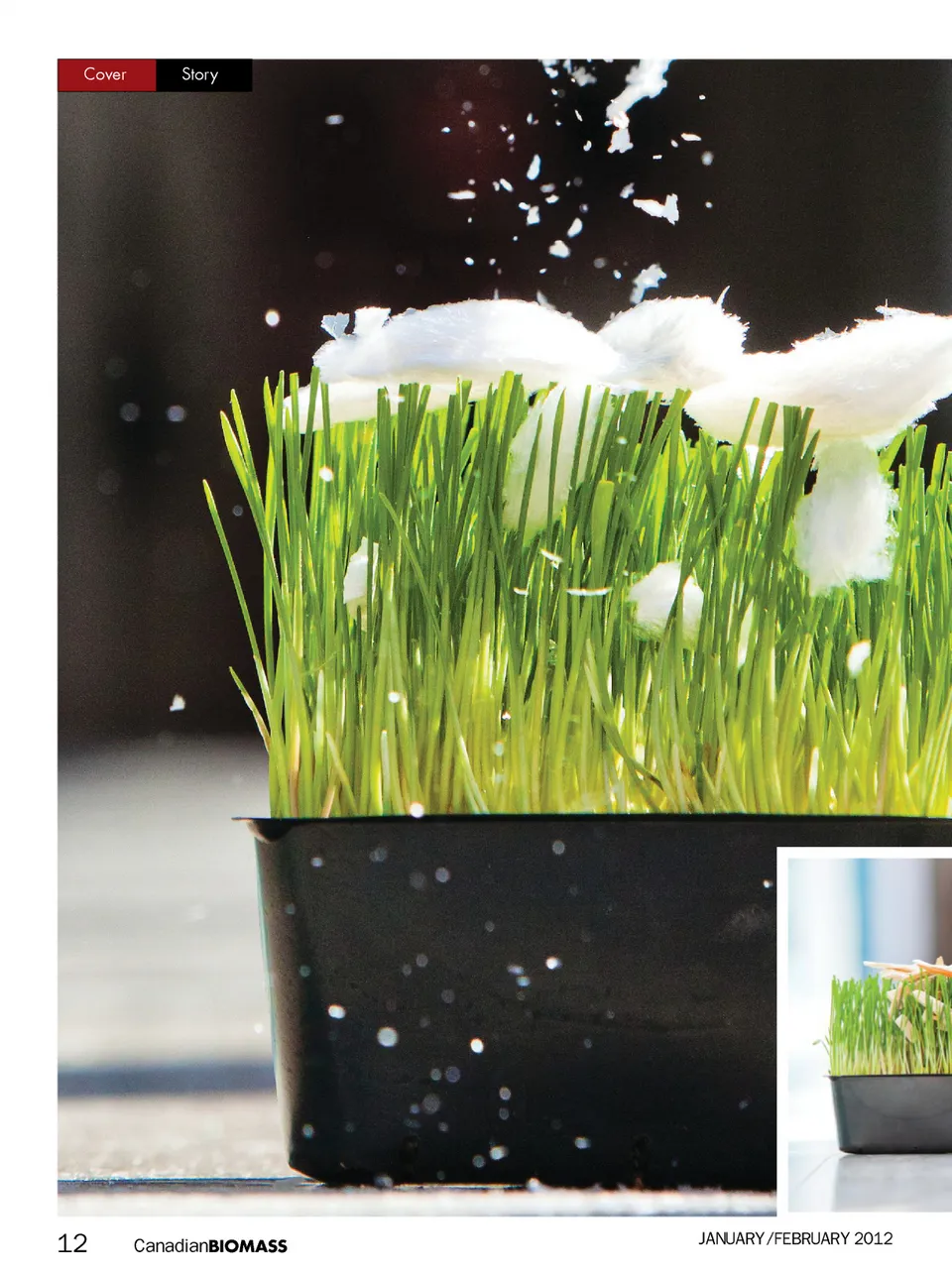
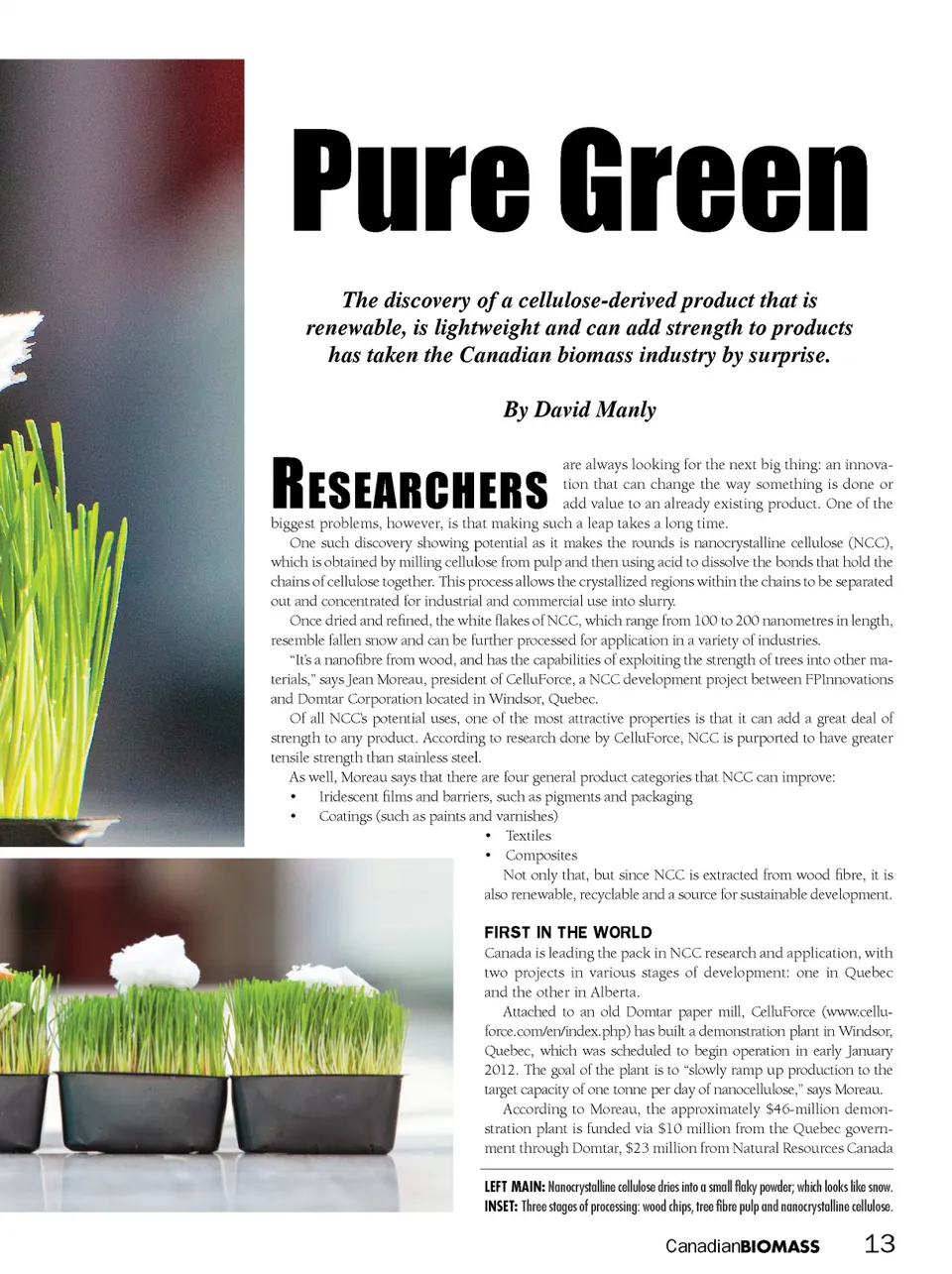
Pure Green The discovery of a cellulose-derived product that is renewable, is lightweight and can add strength to products has taken the Canadian biomass industry by surprise. By David Manly R eSeaRcheRS are always looking for the next big thing: an innova-tion that can change the way something is done or add value to an already existing product. One of the biggest problems, however, is that making such a leap takes a long time. One such discovery showing potential as it makes the rounds is nanocrystalline cellulose (NCC), which is obtained by milling cellulose from pulp and then using acid to dissolve the bonds that hold the chains of cellulose together. This process allows the crystallized regions within the chains to be separated out and concentrated for industrial and commercial use into slurry. Once dried and refined, the white flakes of NCC, which range from 100 to 200 nanometres in length, resemble fallen snow and can be further processed for application in a variety of industries. “It’s a nanofibre from wood, and has the capabilities of exploiting the strength of trees into other ma-terials,” says Jean Moreau, president of CelluForce, a NCC development project between FPInnovations and Domtar Corporation located in Windsor, Quebec. Of all NCC’s potential uses, one of the most attractive properties is that it can add a great deal of strength to any product. According to research done by CelluForce, NCC is purported to have greater tensile strength than stainless steel. As well, Moreau says that there are four general product categories that NCC can improve: • Iridescent films and barriers, such as pigments and packaging • Coatings (such as paints and varnishes) • Textiles • Composites Not only that, but since NCC is extracted from wood fibre, it is also renewable, recyclable and a source for sustainable development. First in the WOrld Canada is leading the pack in NCC research and application, with two projects in various stages of development: one in Quebec and the other in Alberta. Attached to an old Domtar paper mill, CelluForce (www.cellu-force.com/en/index.php) has built a demonstration plant in Windsor, Quebec, which was scheduled to begin operation in early January 2012. The goal of the plant is to “slowly ramp up production to the target capacity of one tonne per day of nanocellulose,” says Moreau. According to Moreau, the approximately $46-million demon-stration plant is funded via $10 million from the Quebec govern-ment through Domtar, $23 million from Natural Resources Canada LEFT MAIN: Nanocrystalline cellulose dries into a small flaky powder; which looks like snow. INSET: Three stages of processing: wood chips, tree fibre pulp and nanocrystalline cellulose. Canadian BIOMASS 13
Canadian Biomass January/February 2012: Page 13