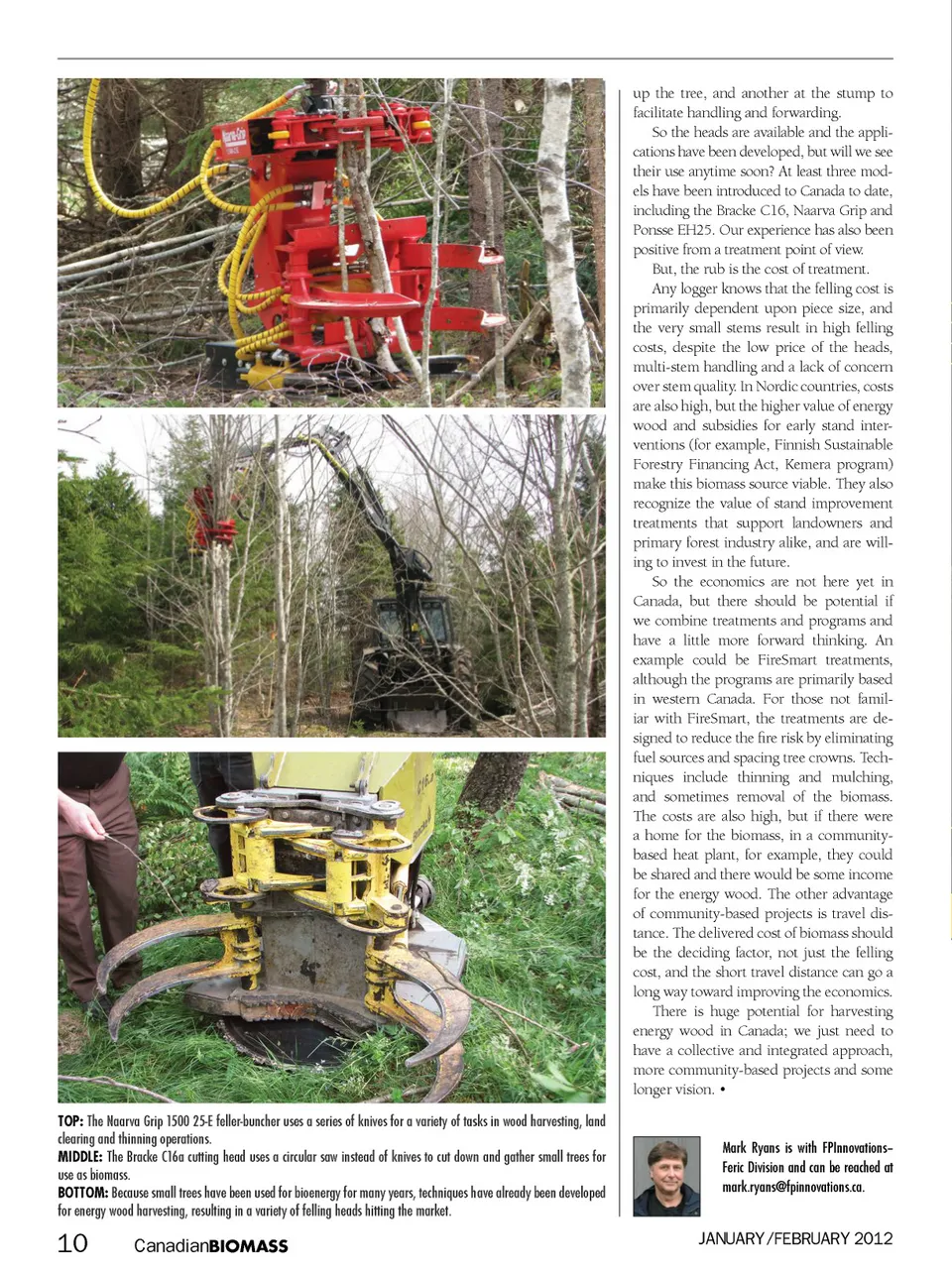
up the tree, and another at the stump to facilitate handling and forwarding. So the heads are available and the appli-cations have been developed, but will we see their use anytime soon? At least three mod-els have been introduced to Canada to date, including the Bracke C16, Naarva Grip and Ponsse EH25. Our experience has also been positive from a treatment point of view. But, the rub is the cost of treatment. Any logger knows that the felling cost is primarily dependent upon piece size, and the very small stems result in high felling costs, despite the low price of the heads, multi-stem handling and a lack of concern over stem quality. In Nordic countries, costs are also high, but the higher value of energy wood and subsidies for early stand inter-ventions (for example, Finnish Sustainable Forestry Financing Act, Kemera program) make this biomass source viable. They also recognize the value of stand improvement treatments that support landowners and primary forest industry alike, and are will-ing to invest in the future. So the economics are not here yet in Canada, but there should be potential if we combine treatments and programs and have a little more forward thinking. An example could be FireSmart treatments, although the programs are primarily based in western Canada. For those not famil-iar with FireSmart, the treatments are de-signed to reduce the fire risk by eliminating fuel sources and spacing tree crowns. Tech-niques include thinning and mulching, and sometimes removal of the biomass. The costs are also high, but if there were a home for the biomass, in a community-based heat plant, for example, they could be shared and there would be some income for the energy wood. The other advantage of community-based projects is travel dis-tance. The delivered cost of biomass should be the deciding factor, not just the felling cost, and the short travel distance can go a long way toward improving the economics. There is huge potential for harvesting energy wood in Canada; we just need to have a collective and integrated approach, more community-based projects and some longer vision. • TOP: The Naarva Grip 1500 25-E feller-buncher uses a series of knives for a variety of tasks in wood harvesting, land clearing and thinning operations. MIDDLE: The Bracke C16a cutting head uses a circular saw instead of knives to cut down and gather small trees for use as biomass. BOTTOM: Because small trees have been used for bioenergy for many years, techniques have already been developed for energy wood harvesting, resulting in a variety of felling heads hitting the market. Mark Ryans is with FPInnovations– Feric Division and can be reached at [email protected]. JANUARY/FEBRUARY 2012 10 Canadian BIOMASS
Canadian Biomass January/February 2012: Page 10